Northern territories, western provinces sign pact to develop critical minerals strategy
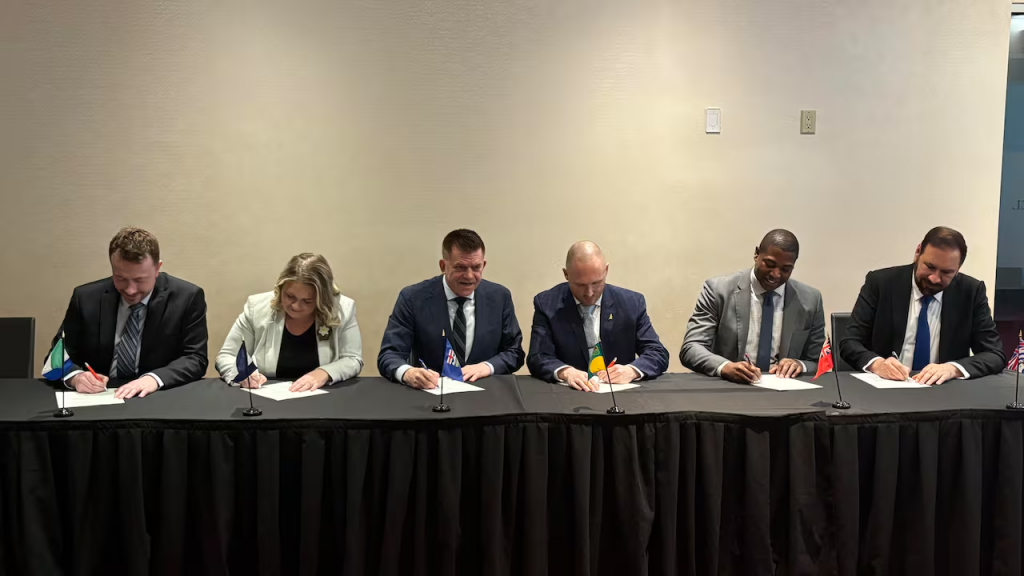
Deal envisions western Canada as ‘global hub for critical minerals innovation and sustainable development’
Western Canada’s provinces and territories are vowing to develop a shared critical minerals strategy together.
The Yukon government signed onto the new agreement Sunday alongside British Columbia, Alberta, Saskatchewan, Manitoba, Nunavut and the Northwest Territories.
Western leaders said the hope is that investing in the mining industry will solve collective problems, from the Yukon’s energy crisis to Canada’s evolving relationship with the U.S.
“Our mining sector will be the foundation of the new economy that Canada is building,” said B.C. Premier David Eby.
The agreement promises to develop the Canadian west as a “global hub for critical minerals innovation and sustainable development” and lay out a list of infrastructure needed to max out critical mineral production, processing and export.
It also pledges to involve Indigenous governments in critical mineral development, including the potential for ownership of projects.
A final version of the strategy is expected in time for a meeting of the seven western mining ministers in June.
The Yukon needs energy to power mining, minister says
Yukon’s Mines Minister Ted Laking said the new agreement recognizes the territory has an urgent winter energy problem.
“The federal government needs to come to the table and help us unlock our mineral potential, and that comes with significant power needs,” he said.
Laking said the Yukon could be a leader when it comes to critical minerals, but right now, the territory’s power grid has little excess power to make available to mines.
A cold snap in December pushed the Yukon’s isolated grid close to maximum capacity. The territorial government even asked existing mines in the territory to switch to their own backup generation to ease the load.
Laking said that incident underscores the need for a major expansion of the Yukon’s electrical capacity. Among the options is a multi-billion dollar transmission line that would connect the territory to B.C.
“We were now at the point of considering rolling blackouts in the city of Whitehorse. We want to get out of that situation and we desperately want to get out of it quickly,” Laking said.
“So what we’re doing is we’re looking at every avenue to find partners to come to the table with us to start developing firm, reliable energy that can turn on in the middle of December.”
With files from Caitrin Pilkington
Related stories from around the North :
Canada: Federal gov’t, Saskatchewan swipe sale of N.W.T. rare earth metals from Chinese buyer, CBC News
Finland: Miners hunting for metals to battery cars threaten Finland’s Sámi reindeer herders’ homeland
Greenland: Greenland’s leader hails EU as trusted friend and urges investment in its minerals, The Associated Press
Sweden: Just how significant is the discovery of rare earth metals in Arctic Sweden?
United States: Washington moves to secure Arctic rare earths with potential stake in Greenland mine, Reuters