
Inuvik service suspension part of broader crisis in maternal healthcare, top ob-gyn says

By Niles Niemuth
Advocate sees role for midwives to play in fixing N.W.T.’s fragile system
Labour and delivery services have been suspended at Inuvik Regional Hospital due to a shortage of physician staff.
The suspension is expected to last through Sunday, with patients redirected to Yellowknife.
However, a public notice from the Northwest Territories Health and Social Services Authority says it could last longer.
Dr. Nicholas Leyland, president of the Society of Obstetricians and Gynecologists of Canada, noted that what’s happening in Inuvik is an acute expression of a broader crisis in Canada’s health-care system.
“The challenges are really not unique to the northern areas,” Leyland said. “It’s similar everywhere, but obviously as a symptom of an ongoing problem across Canada.”

While there is no national tracking, a review of media reports reveals that the suspension of birthing services and unit closures have been an issue in recent years, especially in smaller communities.
Inuvik last saw the loss of services for four months over the summer and fall in 2024 and Yellowknife’s Stanton Territorial Hospital lost services from December 2021 to February 2022.
Leyland explained that there are systemic issues driving these service disruptions and unit closures, including chronic underfunding, high levels of burnout exacerbated by the COVID-19 pandemic, and a decline in family physicians who provide maternity care.
An urgent search for doctors
The territorial health system is urgently recruiting for doctors to fill the gaps that led to this week’s suspension, offering generous benefits in the effort to recruit short-term doctors for Inuvik.
A social media advertisement from Practice N.W.T., the territory’s health and social services recruitment arm, is seeking certified physicians with enhanced surgical skills, obstetrical surgical skills and general surgeons for one- to two-week stints in Inuvik between August and December.
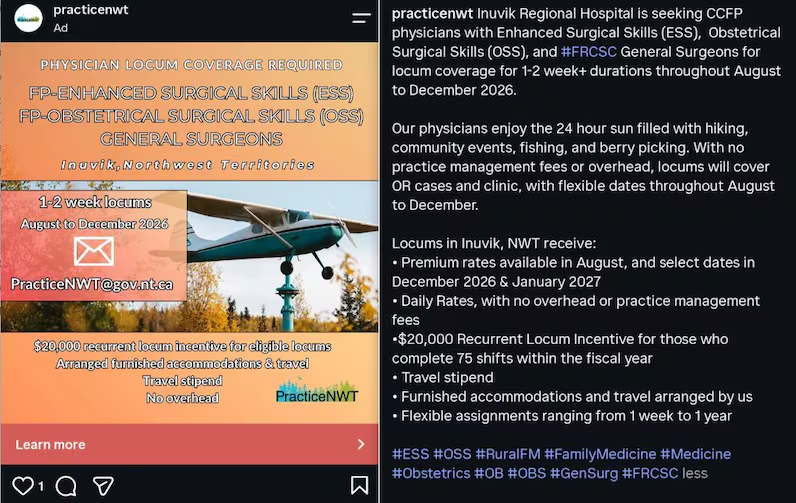
The ad says doctors will get premium rates for August and select dates in December and January. There is also a $20,000 incentive on offer for short-term doctors who complete 75 shifts in the fiscal year.
Other enticements include no overhead or practice management fees, a travel stipend, furnished accommodations and travel arranged by the health authority.
But Leyland said that pay and perks alone will not resolve the structural issues plaguing Canada’s health-care system.
“Over the years, many of the more senior nurses have left the profession… creating a gap in terms of the training of the next generation of obstetrical nurses,” he explained. “So we really have to support the nurses to be able to stay within the profession.”
A role for midwifery
Lesley Paulette, a long-time advocate for midwifery in the N.W.T., says the services they offer could be part of a lasting solution.
“To stabilize our whole maternal [and] child health service here, we have to recruit the right mix of care providers — and that includes physicians, specialists, midwives, [and] nurses,” she said. “Then, we have to work on creating models of care that empower all of those care providers.”

Paulette was appointed to the Order of Canada for her work bringing midwifery back to the territory. Qualified midwives are able to provide a full range of care — before, during and after birth — in homes and in hospital birthing units.
She said this support, in conjunction with more doctors and nurses, could help fix a fragile maternal health-care system.
Related stories from around the North:
Canada: Yukon’s find-a-health-provider waitlist down by half as territory welcomes new doctors, CBC News
Finland: Brakes on Lapland health cuts a win for Arctic communities, says Sami Parliament, Eye on the Arctic
United States: Senators, including Alaska’s, sound alarm on cuts impacting Indigenous health care agency, Eye on the Arctic