N.W.T. industry minister makes case for new federal mining incentives
Focus on exploration credit top-up and clean energy expansion for zinc
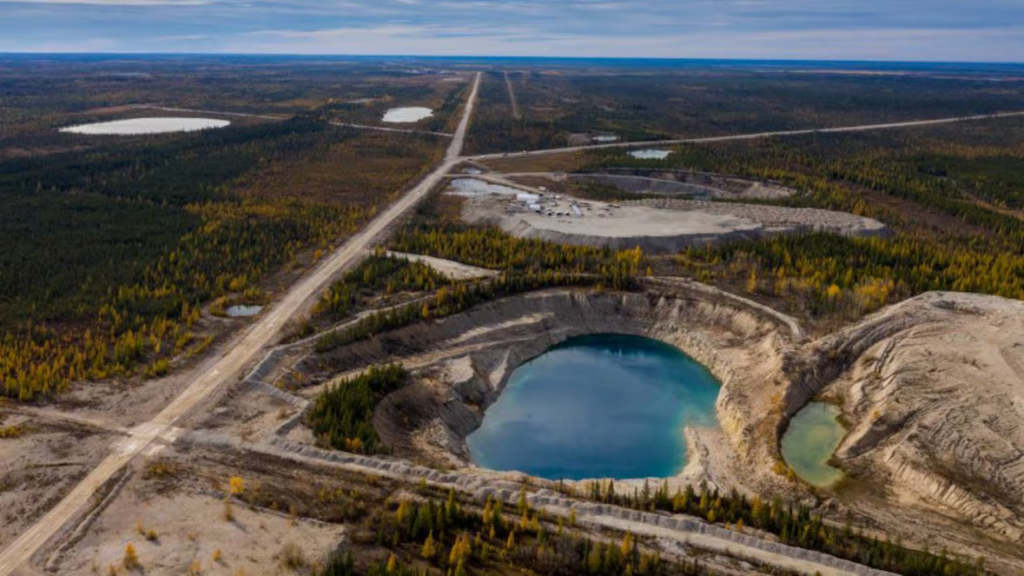
While in Ottawa last week, N.W.T. Minister of Industry, Tourism and Investment Caitlin Cleveland took time to advocate for new federal tax credits which she says will jump-start mining in the territory, and across the North.
Cleveland was part of a delegation of government ministers and Indigenous leaders with the N.W.T. Council of Leaders pushing for investment in major projects.
As first reported by Cabin Radio, Cleveland was lobbying the federal government to enact the North of 60 Mineral Exploration Tax Credit, a proposed 15 per cent stackable tax incentive, that could be used by companies with projects in all three northern territories — N.W.T., Nunavut and the Yukon — to add on to benefits from existing national exploration credits.
The second change she asked for is the inclusion of zinc in the list of minerals that are eligible for a clean technology manufacturing investment tax credit.
The feds currently give a 30 per cent refundable tax credit for capital costs on machinery and equipment used to mine a suite of 11 minerals, but zinc is not on that list. Cleveland explained it is a critical component in renewable energy and power storage.
She said the mineral’s continued exclusion was a “misstep” by Ottawa.
Tax credits seen as critical to new mining projects
The minister argued that enacting both tax credits would be critical to boosting new mining projects in the territories in the face of stiff global competition, but had yet to see a reason why Ottawa had not included them in their recent budget proposals.
“The conversations last week with my counterparts remained positive and just really a role of making sure that people understand why these tax credits are important,” Cleveland told CBC News.
She noted the territory has entered into an ebb in mining activity with diamond mines closed or closing and no projects coming immediately online to replace them.
Cleveland said with the federal government’s emphasis on major projects in the North, the Arctic Economic and Security Corridor, and the Mackenzie Valley Highway, it is critical to take advantage of the opportunity those major projects present for a host of mining projects.
“Making sure that the timing is right means that we need to see that exploration expansion today and making sure that we don’t run into the same situation we’re in right now,” she said.
A handful of critical mineral projects were highlighted by the government last month at Prime Minister Mark Carney’s Canada Investment Summit which include zinc in their deposits and are seeking to work off of pre-existing infrastructure and permitting.
Cleveland said the proponents of the PC Silver and Pine Point mines were keen to see zinc included in the clean energy tax credit. She said that it would be a “game changer” in getting their projects off the ground and for growing Canada’s national production capacity.
She said that the two combined could account for 1,000 jobs during the construction phase and 600 during operation.
A decade-long push by mining advocates
The N.W.T. and Nunavut Chamber of Mines first put forward a proposal for a North of 60 exploration tax credit in 2014. Current CEO Paul Hébert argues that it should be as high as 20 per cent.
He said that the populations of the three territories, and their tax base, are not large enough to pay for the incentives needed to make the North competitive in mine development with southern Canada. He says help is needed from the federal government to attract new business.
“It would make a difference from a tax perspective in making the territories the most attractive investment jurisdictions from a taxation point of view for investors,” Hébert said, referring to the added tax credit.
After more than a decade of work by the chamber to get new tax incentives, he expects Ottawa to take action, referencing another recent announcement of a mega-deduction tax credit.
“I think there will be movement. We’ve already seen tremendous movement in policy support from the government of Canada for the Canadian mining industry,” Hébert said.
Related stories from around the North:
Canada: South Korean president says Arctic trial run is first step toward regular commercial service…including in future Canada, Eye on the Arctic
Greenland: Greenland rules out winter 2026-27 drilling for Nunap Qeqqa/Jameson Land oil project, Eye on the Arctic
Norway: Resource extraction projects, dwindling sea ice, power Arctic shipping surge, Eye on the Arctic
Russia: Mounting war-time trade between Moscow and Beijing expands in the Arctic, The Independent Barents Observer
United States: Trump says oil, gas and mineral exploration in Greenland is set to begin. It’s not that simple, The Canadian Press