Traditional knowledge can help limit exposure to contaminants, researcher says
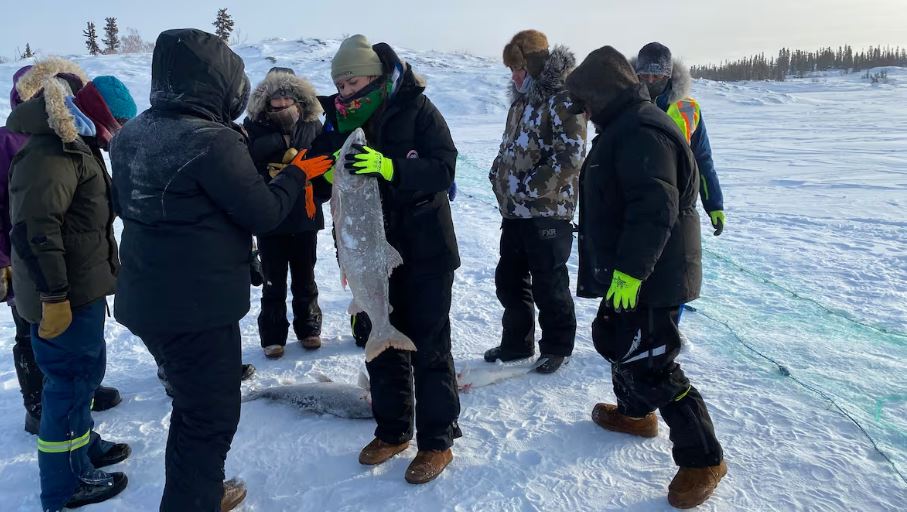
Traditional knowledge and harvesting practices may help limit the buildup of contaminants such as mercury in people who live in northern Indigenous communities in the N.W.T. and Yukon, researchers say.
A recently-published study in the International Journal of Hygiene and Environmental Health examined data collected from more than 600 residents in the Dehcho and Sahtu regions of the N.W.T. and in Old Crow, Yukon, between 2016 and 2019.
They measured concentrations of mercury, as well as healthy omega-3 fatty acids, in hair and blood samples and compared that data to dietary and demographic factors.
The researchers say that foods such as lake trout, ducks and geese are an important part of many Indigenous communities’ diets. They also found that they’re associated with higher mercury levels measured in hair samples, especially of people in the N.W.T.’s Sahtu region, compared with the Canadian population as a whole.
However, they also found that total mercury exposure among the study participants was relatively low, and within health guidelines.

The scientists are working to highlight the importance of traditional foods while measuring contaminants and exploring ways to reduce their entry into the Arctic ecosystem, said Brian Laird, a professor at University of Waterloo’s public health sciences school, and lead author of the study.
“What we’re really trying to emphasize is that even though in environmental monitoring studies we can sometimes find high levels of contaminants, like mercury in traditional foods, that there are many people who rely on those traditional foods,” he said.
‘A butterfly flapping its wings in the northern hemisphere creates a hurricane in the southern hemisphere’
Laird said mercury is released in the environment through natural and man-made sources.
Natural sources of mercury include forest fires and volcanic eruptions, he said. But it is human activities such as burning of coal and gold mining in Central and South America that have contributed to higher mercury levels in the environment, he said.
“Mercury is able to travel worldwide and can eventually be deposited in Canada where it can build up in food chains,” he said.
The famous analogy — that a butterfly flapping its wings in the northern hemisphere can create a hurricane in the southern hemisphere — fits here, he said.
“Contaminants, they don’t respect borders. So they travel worldwide. And most of the mercury that lands in Canada comes from outside of Canada.”
Laird said one reason mercury found in the communities are within safe levels is because they tend to follow traditional diets that change with the seasons.
“People aren’t eating the same fish or the same meat every day, every week for the whole year,” he said.
“The body has time to flush out those contaminants while they’re eating other things. Mercury is a type of contaminant that the body is able to eliminate slowly while people are exposed to less of it.”
Elders guide communities
Jonathan Yakeleya of Tulı́t’a, N.W.T., was a research co-ordinator for the study and said he was surprised when he first heard about the levels of contaminants.
“We’ve always depended on wildlife. It’s our main source of food,” said Yakeleya, who is with the Sahtu Renewable Resources Board. “We know that climate change is happening. And there are impacts that come with climate change.”
Climate change is associated with drought and wildfires and that affects local food sources, he said, including the presence of contaminants. Studies like the one led by Laird can help communities prepare and adapt, he added.
Communities are also turning to their elders as they see the effects of climate change around them, Yakeleya said.
“There’s certain areas that we have to harvest from,” he said, giving an example of how elders guide the community.
“What’s the safe water to drink? What’s not safe water to drink? … That’s where the knowledge is very, very important because without knowledge — ‘where do I fish? Where do I hunt? Where do I get water?’”
An article by Hina Alam
Related stories from around the North:
Canada: Pehdzéh Kı̨ seeks confidentiality for traditional knowledge on proposed Mackenzie Valley Highway, CBC News
Finland: Stricter mining regulations and oversight needed in the Arctic, Finnish report says, Yle News
Norway: “The ‘Smart Arctic’ is Indigenous,” Saami leader tells Arctic Frontiers, The Independent Barents Observer
United States: In debate over Alaska drilling, two Indigenous representatives clash, Cryopolitics Blog