Nordic leaders meet in Oslo as Arctic tensions sharpen over Greenland, Russia
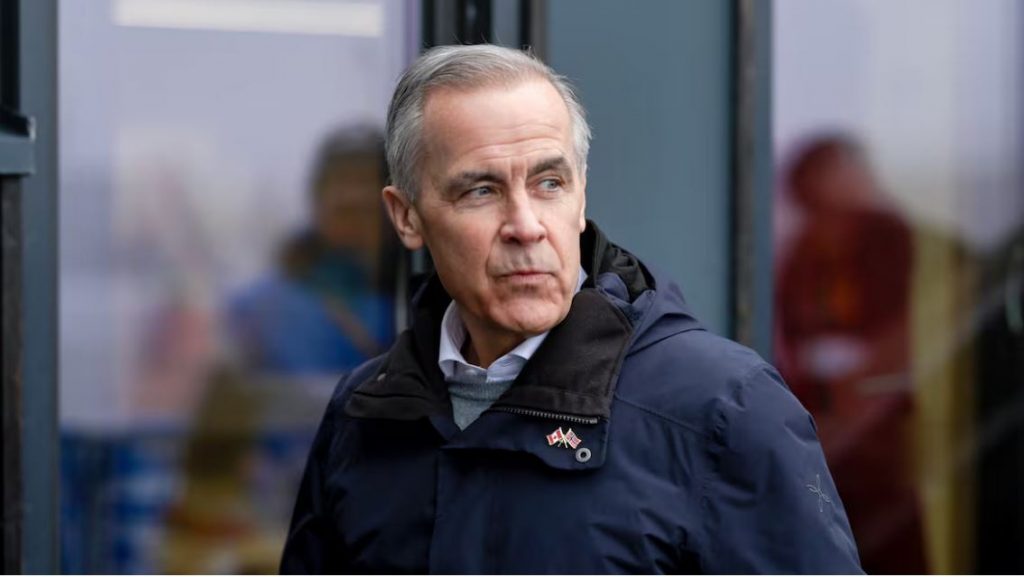
The leaders of five Nordic countries — plus Canada — gathered in Oslo for a mini-summit to discuss strengthening defence capabilities in the face of higher international tensions, including recent threats by the Trump administration to take over Greenland.
The meeting on Sunday was the last stop in Norway for Prime Minister Mark Carney, who arrived early Friday to witness a major NATO military exercise in the northern part of the country involving more than 30,000 troops, sailors and aircrew.
Carney was asked pointedly by the Danish media whether Canada would commit troops to defend Greenland against threats of U.S. annexation by the Trump administration.
“We stand four square behind the principles of sovereignty, territorial integrity. It is for the people of Greenland and Denmark to decide their futures,” Carney said. “We will back that with measures as necessary.”
Denmark has bolstered its military presence on the Arctic island, which is a quasi-independent territory within the Danish kingdom. Other allies — France, Germany and Sweden — sent troops to further buttress Greenland’s defences through a military exercise. Canada considered sending a contingent of troops but has not yet committed.
While U.S. President Donald Trump has backed off his annexation threats for now, all of the leaders were unanimous that Greenland’s future should be decided by Greenlanders — and the show of solidarity was appreciated by Denmark’s prime minister.
“I am very grateful, I have to say this, for all the help we have received in the Kingdom of Denmark. Greenland and Denmark, we have had a totally unacceptable pressure from [the] U.S. and the U. S. president,” said Mette Frederiksen, who singled out Carney in her remarks.
“And one of the reasons why we have been able to stand firmly on very common values — that you have to respect sovereign states, that you respect a people’s right for self-determination — is because of our good friends in the Nordic countries, in Europe, but also with partners outside, especially you, Mark. So from the bottom of my heart, thank you for that.”
The North Atlantic Treaty Organization, whose members include all of the countries gathering in Oslo, has started an initiative known as Arctic Sentry to better co-ordinate military activity in the region.
Icelandic Prime Minister Kristrún Mjöll Frostadóttir suggested the crisis over Greenland has helped focus NATO’s attention on the region, which she suggested is long overdue.
“Iceland has obviously felt the pressure and felt the sort of shift in action around us. We’ve been worried about Greenland. We’re obviously worried in general about the situation in Europe when it comes to Ukraine, but we’re not afraid,” she said.
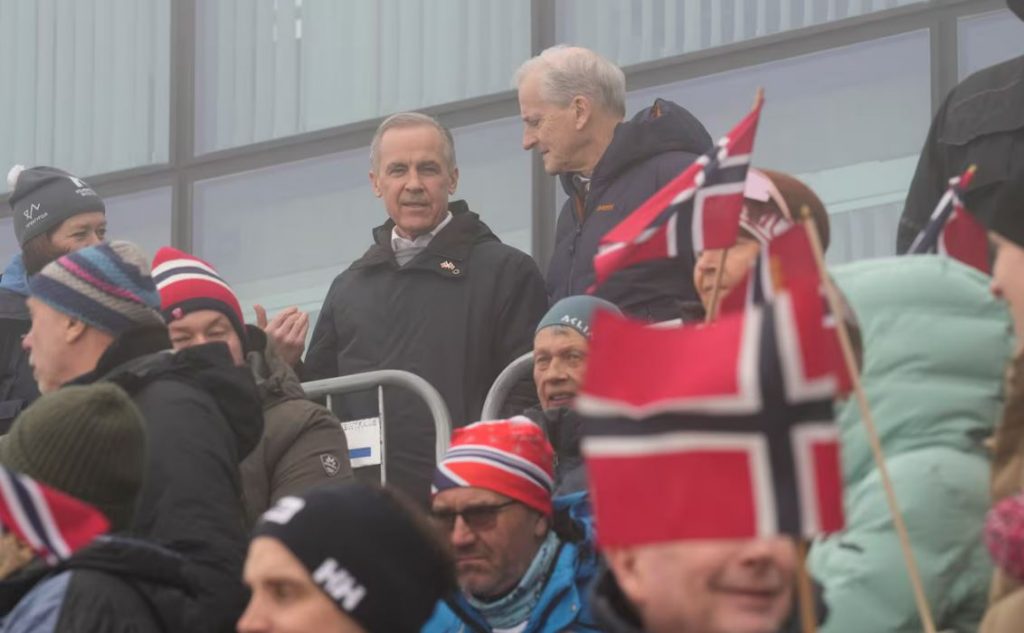
Norwegian Prime Minister Jonas Gahr Støre said Nordic nations and Canada support human rights and the sanctity of international law.
“We believe that these six countries are not weak countries, they are strong countries in terms of their values, in terms of their determination,” he said during the closing news conference.
The Nordic leaders issued a joint communiqué that referred among other things to deepening defence industry co-operation. That’s significant because Norway is one of the two countries involved in the German TKMS bid to sell submarines to Canada.
Throughout his trip, Carney was hit with questions from the German media on Friday and the Norwegian media on Sunday, basically asking why he hadn’t made a decision on the bids.
In both cases, the prime minister explained that the bids have just been submitted and they’re being evaluated. He said it wouldn’t be appropriate for the leaders to discuss them now that they’re in the hands of officials.
The war in the Middle East and its effect on energy prices also figured prominently in the talks. Støre said supporting conditions for de-escalation remains a shared priority.
“We are not part of this war. We did not initiate it, but we are all affected by it,” he said. “So I think there’s a clear call here that international law must be respected, and it should be the responsibility of the concerned parties to find ways of ending the hostilities that now have great impact around the world.”
The meeting was held in the wake of a major, comprehensive report last month by the U.S. policy think-tank the Atlantic Council. It warned that Russia’s economy is more resilient than expected and has largely transitioned to war footing.
The report lays out five stark scenarios of potential moves that Russian President Vladimir Putin could make against the Nordic and Baltic countries, if Moscow ever achieves a victory in its long-running war to subjugate Ukraine.
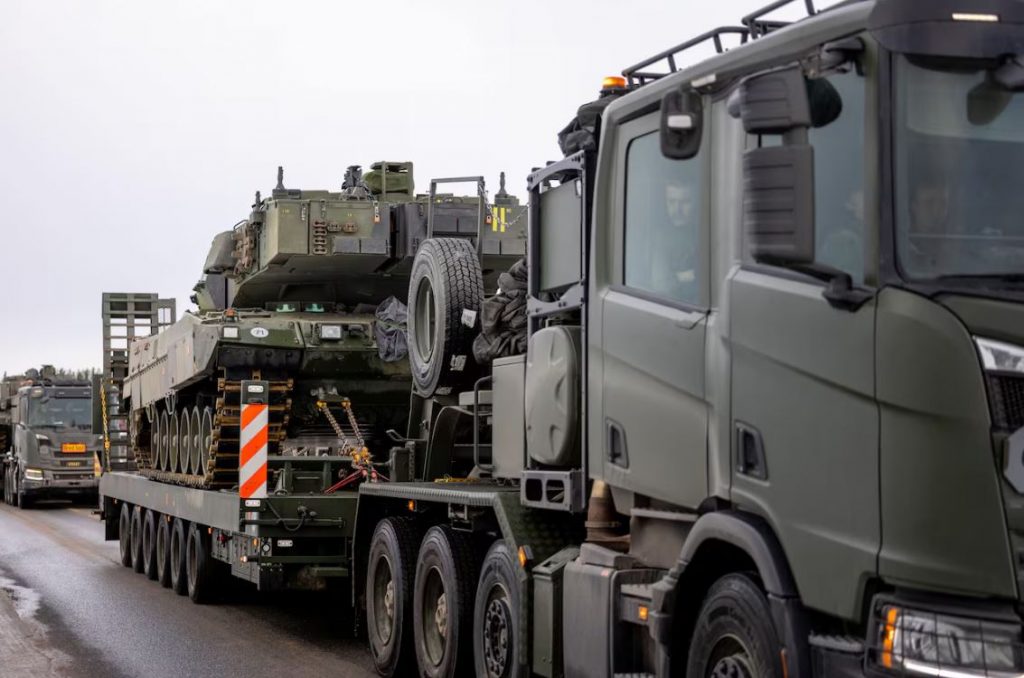
Three of the five scenarios involve Russian forces seizing key islands off Norway, Finland and Sweden in so-called low-risk operations in order to test NATO’s resolve. Such attacks would trigger the allies’ all for-one, one-for-all clause in the Washington Treaty.
The Western military alliance has said it will defend every square inch of allied territory, but as the council’s report points out, there could be less involvement in NATO by the United States in the coming years.
“If Putin succeeds in such tests, the lack of an effective response could well fracture NATO, fundamentally altering the transatlantic security environment,” the report said.
Mathieu Boulègue, a senior fellow with the Center for European Policy Analysis, said the leaders need to have a constructive discussion about security in the Arctic.
“Geopolitics is definitely present in the region, and we need to address the constant insecurity, from sub-threshold operations to kinetic actions to nuclear sabre-rattling from the Kremlin,” he said.
“And if not the Kremlin now, China later. So we need to hone our deterrence posture, we need to hone our presence in the region to be more assertive and to make sure that we defend the national interests of the Arctic.”
Related stories from around the North:
Canada: Canada bets on ‘Build at Home’ defence strategy to reclaim sovereignty — and revive readiness, CBC News
Denmark: Denmark to provide four F-35 fighter jets to NATO’s Arctic Sentry, Reuters
Finland: Greenland clash left a mark on EU-US relations says Finnish PM, Yle News
Greenland: New Italy Arctic policy adds U.S. Greenland ambitions to growing Arctic competition narrative, Eye on the Arctic
Iceland: NATO chief to Arctic Allies: “We’re all frontline states now,” as Iceland’s role grows, Eye on the Arctic
Norway: Europeans step up submarine hunting in the North, The Independent Barents Observer
Russia: Russia claims first-ever North Pole aerial refuelling, TASS reports, Reuters
Sweden: Swedish military intelligence on the great power rivalry over Greenland, Radio Sweden
United States: Rubio says technical talks with Denmark, Greenland officials over Arctic security have begun, The Associated Press