Experts say Canada should track underwater noises in Arctic to help marine wildlife
Scientists are monitoring how Cambridge Bay, Nunavut, is getting louder.
It is getting loud beneath the waves around Cambridge Bay, Nunavut.
From the thrum of ships to the roar of all-terrain vehicles and aircrafts in the skies, marine animals must now compete with the din created by humans.
Lyne Morissette, a marine biologist with Ocean Networks Canada, compared the underwater environment with trying to communicate in a noisy place.
“If you go to a rock concert with your friend and you’re trying to speak with them, chances are you won’t be able to share your message efficiently,” she said.
“It’s the same for whales and for belugas and narwhals, for example, the animals that we mostly see in the Arctic.”
Ocean Networks Canada is a nonprofit with observatories that capture a wide range of sounds in the Arctic, including marine shipping, ice cracking, small fishing vessels and snowmobiles.
The organization collects data using hydrophones, specialized microphones placed just beneath the surface of water or ice that can record the whistles of dolphins, calls of humpback whales, reverberations caused by ships, and even the on-shore sounds of all-terrain vehicles and snow boots.
‘Oh, lots of nice fish’
Under the waves, sea creatures are a surprisingly talkative bunch.
Animals underwater use sound to communicate with each other, said Philippe Blondel, a senior lecturer at the University of Bath’s physics department.
“It can be: ‘How are you doing? Do you have fish on your side? Stay close to your mommy because there is a shark coming,’” he said.
“It can be to find prey – ‘oh, lots of nice fish’ – or to avoid being prey. Sound is very important for animals. Very often, the water is dark and especially in the Arctic winter it can be very dark anyway. So sound is the primary mode of communicating, navigating and living.”
A recent study led by Blondel about Cambridge Bay in the journal npj Acoustics said rising temperatures are changing the landscape of the Arctic, including opening up routes for ships, tourism, oil, gas and mineral exploration year-round. All this leads to an increase of manmade underwater noises. One such route is the more than 3,100-kilometre long Northwest Passage, a corridor connecting the Atlantic to the Pacific.
Cambridge Bay was chosen for the study because of the immense amount of data available through Ocean Networks Canada and the area’s importance as a shipping route.
Blondel said his study draws on more than a decade of records collected by Ocean Networks Canada.
Not all noise comes from large ships, he said. Some of it is from snowmobiles, small boats and airplanes overhead, and not all of them are loud, he added.
“The idea was to measure what is going on now when the Arctic is still quiet and relatively untouched, to find out what makes loud noises,” he said. “Can we regulate that or monitor what’s going on?”
Sound travels further in water
Noise travels further and faster underwater, Blondel said. Sound from oil rigs in Alaska can be heard in the Yukon, he said, giving an example.
“I remember talking to a scientist studying whales north of the Bering Strait, and he could hear air guns that were actually coming from north of Norway.”
Fisheries and Oceans Canada’s website says sound travels about 4.5 times faster in seawater than in air.
Morissette said acoustics are the cornerstone of communication for some marine animals, such as cetaceans.
“This is the sense that they are going to use the most to find their food, to socialize, to play, to navigate their ecosystem, to perceive their environment and to get the information from their habitat.”
Giving the example of grey whales, which are usually found North Pacific, Morissette said the animals “adjust” their behaviour when noise around them increases — either by singing more or louder — to get their message across.
Stress from noise also causes behavioural changes because the animals will try to get away from the disturbance, causing them to potentially move far away from food sources and breeding grounds, she said.
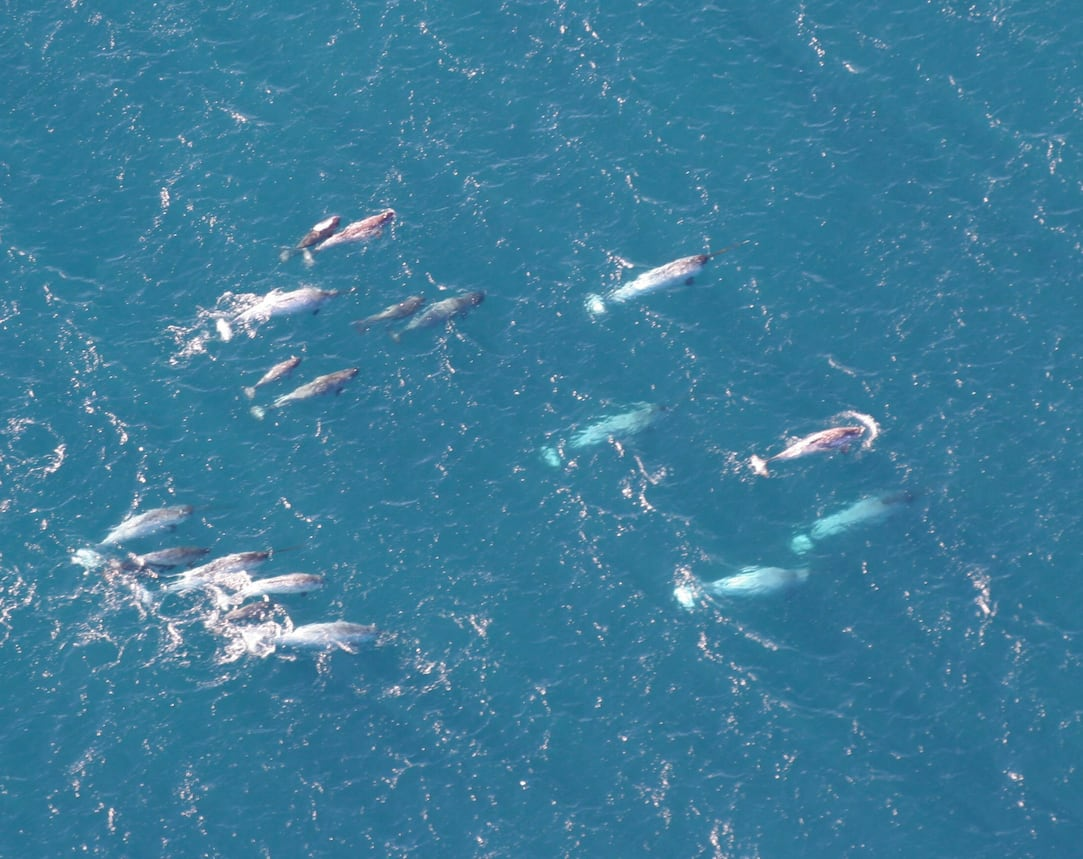
Morissette said the observatory at Cambridge Bay, Nunavut, will help track changes as routes open up to large ships and cruise lines.
“They are dealing with changes in the ecosystem. Their food is not at the same place. Climate change is affecting them as well,” she said. “It’s just another layer of challenge that the animals in the Arctic are facing.”
Need for regulations
Blondel said he hopes the data collected can be used to establish a framework of regulations to ensure the safety of marine creatures.
He pointed to Europe’s regulations for open waters, which include monitoring noise from shipping, drilling and dredging among other activities.
But what works for Europe’s waters may not work for Canada, and the country should develop its own regulations before it’s too late, he warned.
Underwater noise pollution doesn’t just hurt animals, it also affects Indigenous communities who rely on fish in the area, he said.
“We need to keep monitoring because as there will be more ships, it’s going to create more noise,” Blondel said. “And we have to say, ‘wait, this is not sustainable. That’s not going to be good for the environment … for the animals.’ It can frighten some fish away. So the local fishermen suddenly don’t have any fish because every fish moved away.”
· CBC News