Hundreds march in Whitehorse to protest manslaughter conviction

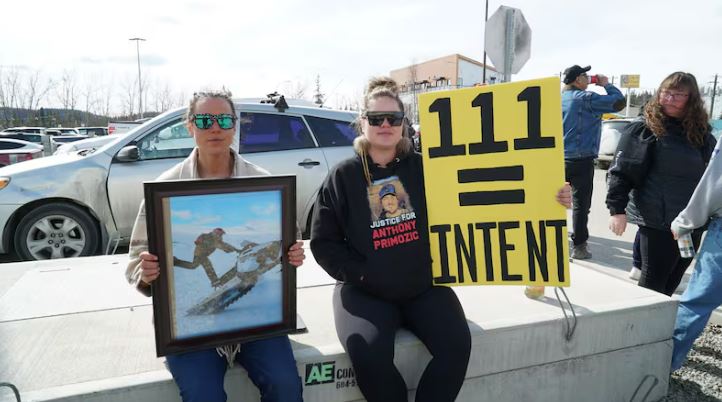
About 450 people gathered in downtown Whitehorse Tuesday to protest a recent Yukon Supreme Court decision and advocate for judicial reform.
The protest was led by the family of Anthony Primozic, who was killed in the early morning of March 9, 2022, in his home in Haines Junction.
Primozic’s family said it wants the justice system to stop accepting intoxication as a defence against murder.
The man responsible for ending Primozic’s life, Seth Boss, was found not guilty of second-degree murder after a Yukon Supreme Court judge ruled that Boss’ intent to kill Primozic was not proven beyond a reasonable doubt. Boss’ defence was that he was too intoxicated to form intent.
The court heard that Boss hit Primozic over the head with an electric guitar, left ligature marks around his neck and stabbed him 111 times, leaving puncture wounds from his face to his lower abdomen.
Boss was convicted of manslaughter, a lesser charge, on April 21.
The conviction sparked outrage, culminating in a protest organized and led by Primozic’s family.

Hundreds of people held signs and wore t-shirts printed with photos of Primozic. The crowd gathered at the legislative assembly and marched to the Whitehorse courthouse, stopping several times to count to 111 to signify the number of times Primozic was stabbed.
When the procession reached the courthouse, it was met by a line of people holding numbered pages, counting from 0 to 111.
Primozic’s sister, Matsʼäsä̀na Mą Primozic, led the procession. She said her family wants the court system to rethink how it addresses intoxication as a defence against murder charges.
While second-degree murder holds a minimum life sentence, manslaughter convictions do not have a minimum sentence.
Matsʼäsä̀na Mą said her family is terrified that Boss might walk free in a couple of years or less. At the protest, the crowd was encouraged to write victim impact statements to the court for consideration at Boss’ sentencing.
“It’s not just my family that feels terrified,” she said, noting that Boss was charged with new offences in Lower Post, B.C., just a few months after Primozic died. “Whose brother, whose sister, whose son, whose daughter, who will be next?”
According to court documents, Boss was charged with assault and break-and-enter in December 2022 but was given a suspended sentence on a lesser charge and given six months of probation.
Two First Nations barring Boss from their communities
Seth Boss is not welcome to return to Champagne and Aishihik settlement lands or his home community of Lower Post, B.C., according to leaders in both communities. Boss is currently detained and awaiting sentencing.
The Daylu Dena Council issued a proclamation the day after Boss’ sentencing. It says Boss is not welcome to visit or reside in Lower Post, B.C. It says the prohibition remains in place until the chief and council lift it in writing. It’s signed by Daylu Dena Council Deputy Chief Harlan Schilling and two councillors.
The Champagne and Aishihik First Nations said Boss is banned from Champagne and Aishihik communities, including settlement lands and First Nation-owned buildings. He is also barred from Champagne and Aishihik events.
Champagne and Aishihik Chief Barb Joe said they initially banished Boss after he was charged in 2023 until the end of the criminal hearing. Now, he is banned permanently.
“Members of the community need to feel safe,” Joe said in a phone interview. She said the First Nation plans to enlist the RCMP’s support in enforcing the ban.
“There was a lot of shock, rage, anger,” Joe said.
Now, the First Nation is looking to political advocacy, to fight for judicial reform. She said there are a few points of focus right now – including arguing against intoxication as a defence, addressing minimum sentences for manslaughter, and assessing the appropriateness of Gladue Reports during sentencing for serious crimes.
“We will now focus on the change that has to get done,” Joe said. “There’s got to be a better way of dealing with these situations.”
A report written by Gabrielle Plonka
Related stories from around the North:
Canada: Canada’s northern justice system needs victim-focused overhaul, national inquiry told, Radio Canada International
Finland: Police in Northern Finland overstretched, says retiring officer, YLE News
Sweden: Report sheds light on Swedish minority’s historic mistreatment, Radio Sweden
United States: Alaska’s crime rates are soaring, stats show, Alaska Public Media