
How Kakisa, N.W.T., is making a fire break part of its plan to grow more food
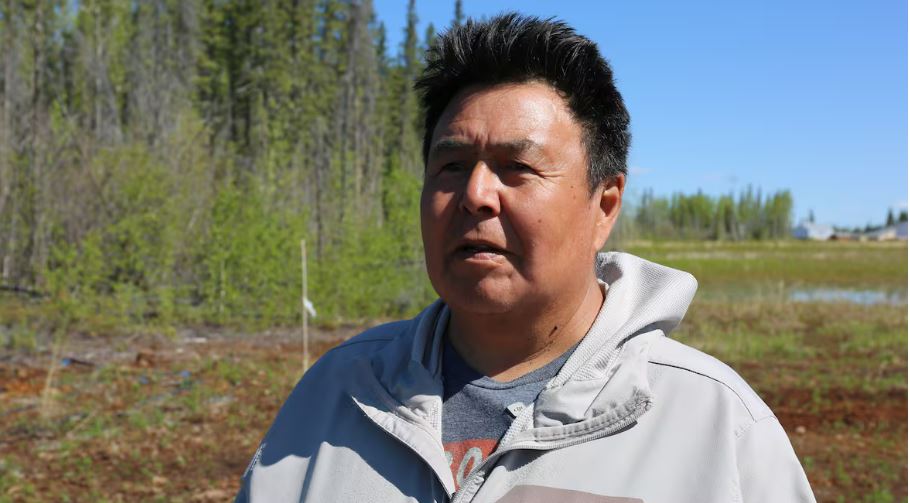
When a wildfire reached Kakisa in 2014, burning around the community on two sides and along its access road, it decimated many berry bushes that grew in the area.
Now, the N.W.T.’s smallest community is using one of the fire breaks protecting it from future wildfires to bring back those berries — and closer to home.
“If it’s going be always there, why not plant berries,” said Ka’a’gee Tu First Nation Chief Lloyd Chicot. “Rather than just taking all the trees down and leaving it there.”
The berry patch is a pilot project involving the First Nation and a team of researchers from Wilfrid Laurier University who have been working with the community of just under 40 people for 13 years.
Planted in 2024, some of the berry plants gave their first modest yield last summer.
They complement some of the community’s other efforts to grow more food in a place where the closest grocery store is nearly 70 kilometres away.
Growing the berries
Planted right at the edge of a fire break south of the community, the berry patch is near a spot where wild blueberries and cloudberries already grow and is positioned so as not to get in the way of wildfire crews.
About 50 cranberry, raspberry, strawberry and Saskatoon berry plants make up the patch, with irrigation lines interspersed between the rows.
Chicot said people in the community have been excited to see what would and wouldn’t grow.
The plants were chosen because they already naturally grow around Kakisa. When it came time to plant, the community decided to transplant them from the bush rather than order the berries from elsewhere.
Julian Canadien, who has been working for five years on the community’s garden and berry patch initiatives, said it took a bit of time to find the plants, but it was worth the effort.
He used to work as a firefighter. Now the water pumps he used to rely on to help fight fires allow him to water plants in Kakisa.
He said he used to notice all the berries while fighting fires and would come home thinking it would be worth growing them.
“I used to watch things burn,” he said. “Now I’m growing things, so it’s a learning experience for me.”
A link to traditional harvesting
Canadien’s work on the berry patch complements the work he does overseeing the booming community garden that now includes two large greenhouses, a garden plot and several garden boxes.
The community also maintains compost heaps for its plants.
It all feeds into a drive to grow more food in Kakisa.
Chicot said the traditional places where the community stayed in the past had berries, wild potatoes and onions could be harvested.
He said people wanted to bring those foods to where the community is now, so there’ll be plenty of food for everybody.
The berry patch specifically is a way to keep traditional harvesting accessible.
“The majority of the trails were lost during the fires of 2014,” Chicot said.
He said that meant it became harder for people to continue going out to harvest berries, even if some grew back.
Now, there are plans to make the fire break patch even more accessible down the line.
Carla Johnston, a PhD student at Wilfrid Laurier University who has been leading her team’s work on the fire break pilot project, said the community has suggested adding accessible trails to reach it for elders and children.
She said another potential addition suggested by community members is a nearby gathering place where people could sit. It would make it easier for elders to tell stories and share knowledge about the land with the younger generations as they come out to harvest.
A success so far
Now that the pilot project is already proving successful, Johnston said an expansion of the patch is likely one of the next steps.
She said people have been especially excited about cranberries, so those might get prioritized as new plants.
For Chicot, the experiment has been worth it and has brought people together. “From what we’ve experienced here, it’s not only an on-the-land thing,” he said.
Chicot said it’s also demonstrated that it’s possible to go beyond what policies suggest by making fire breaks more than just a big open area offering protection from fires.
“It encourages the whole of the community to come out and see what progress has been made,” he said.
Related stories from around the North:
Canada: ‘So much is being allowed to spoil’: Country food in Nunavut faces distribution challenges, CBC News
Finland: One in 10 Finnish families with young children dealing with food insecurity: survey, Yle News
United States: New farm bill program aims to fight food insecurity in Alaska, Alaska Public Media