
What to know about Greenland’s flag as a potentially perilous fight with US appears to be averted
At the height of tensions among NATO allies over U.S. President Donald Trump’s repeated calls for Greenland to become U.S. territory, he posted online a map of the island covered in the colors of the American flag.
That potentially perilous fight now appears to have been averted after Greenland, Denmark and the United States announced a deal over the future of the icy, mineral-rich territory.
The accord, to be signed Tuesday on the sidelines of the U.N. General Assembly, is set to give the U.S. a bigger military presence on the semiautonomous Danish territory – and could lead to the Stars and Stripes flying more often near Greenland’s own distinctive flag.
Here’s a look at Greenland’s relatively young flag:
A flag with simplicity and symbolism
The flag of the world’s largest island is typical of the most effective flags: Simple in construction.
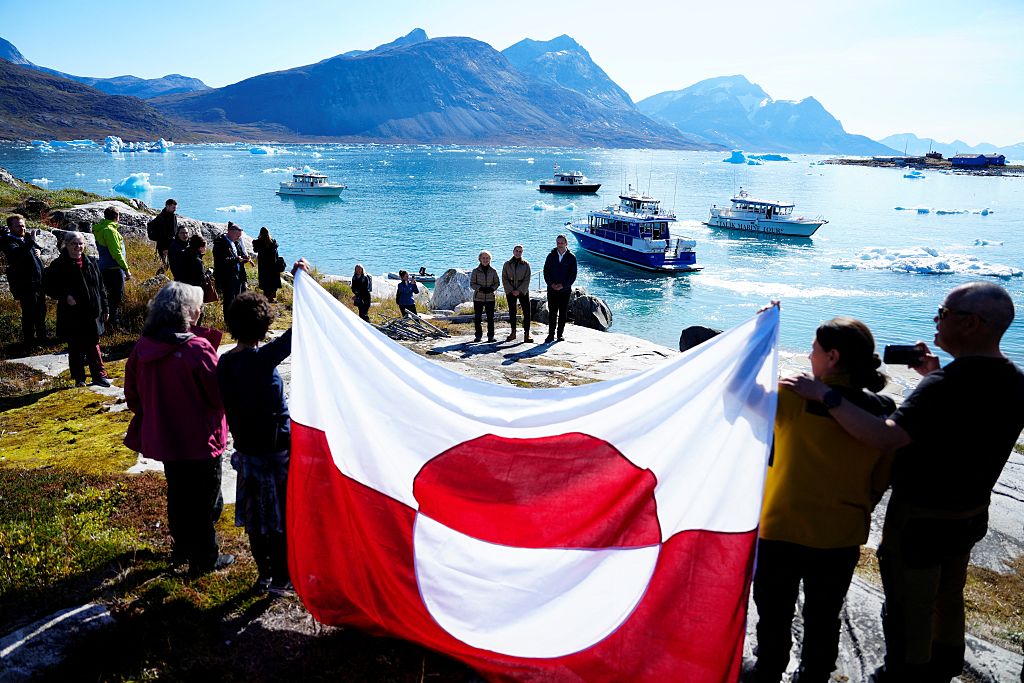
Designed by Greenland native Thue Christiansen, the flag was adopted on June 21, 1985. It features two equal horizontal bands of white and red, and a large circle positioned off-center, slightly closer to the flagpole.
The circle, which like Japan’s flag represents the sun, is “counterchanged” – meaning that it’s divided into red and white in the reverse color of the two bands.
The offset catches the eye and carries symbolism of a sun setting on the horizon, suggestive of the light and relative warmth that return in midsummer to the island. About two-thirds of Greenland sits inside the Arctic Circle.
Longtime links to Denmark feature in the flag
Greenland today is a semiautonomous territory of Denmark, which ruled the island for centuries. The choice of red and white, the same colors of the Danish national flag, reflects that longtime affiliation.
A conscious decision was made to highlight the island’s distinctiveness and autonomy: Unlike the flags of Finland, Norway, Sweden and Denmark itself, Greenland’s flag is the only one representing a Nordic territory without an offset cross.
In Greenlandic, the flag is called both Erfalasorput – “our flag” in Greenlandic – and Aappalaartoq, meaning “the red one.”
A flag is finally chosen after an initial impasse
The notion of a flag for Greenland first surfaced in the early 1970s.
In 1979, the island won home rule from Denmark after a referendum. The new government, the Naalakkersuisut, organized a design contest to create a new national flag: Hundreds of submissions poured in.
Greenland’s parliament was unable to reach consensus, and an impasse took several years to resolve. The choices were winnowed down to two – Christiansen’s design and another featuring a green and white Nordic cross design.
Parliament finally voted in 1985. A narrow majority of members – 14 of 25 – opted for the flag flying over Greenland today.
Related stories from around the North:
Canada: Arctic would be “flagship project” in proposed EU-Canada partnership, von der Leyen says, Eye on the Arctic
Denmark: Denmark says NATO shares responsibility for Arctic security under Greenland deal, Reuters
Greenland: Timeline-Key moments in Trump’s push to control Greenland, Reuters
Russia: Kremlin says Greenland deal with US and Denmark is a matter for those involved, Reuters
United States: Trump touts ‘permanent control’ in Greenland deal as Denmark, Nuuk stress sovereignty, self-determination, Eye on the Arctic