After three decades of Norway, Russia bridge-building comes a plan for detonation
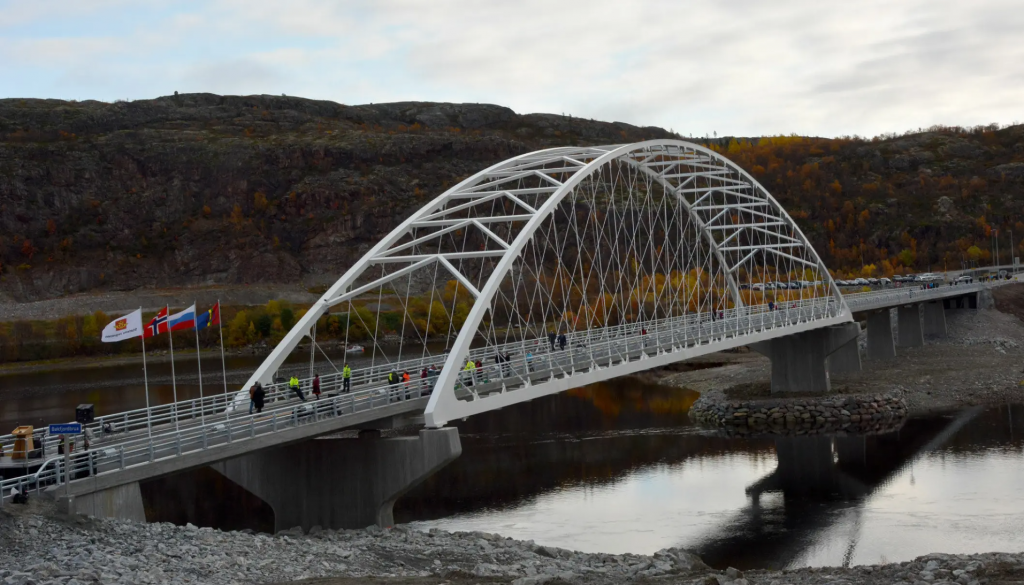
Norway bet on a democratic development in Russia and invested heavily in building bridges – both literally and in a political and human sense, with neighbouring Russian regions. It failed. The government in Oslo is now preparing a plan for blowing up bridges in case of a Russian attack.
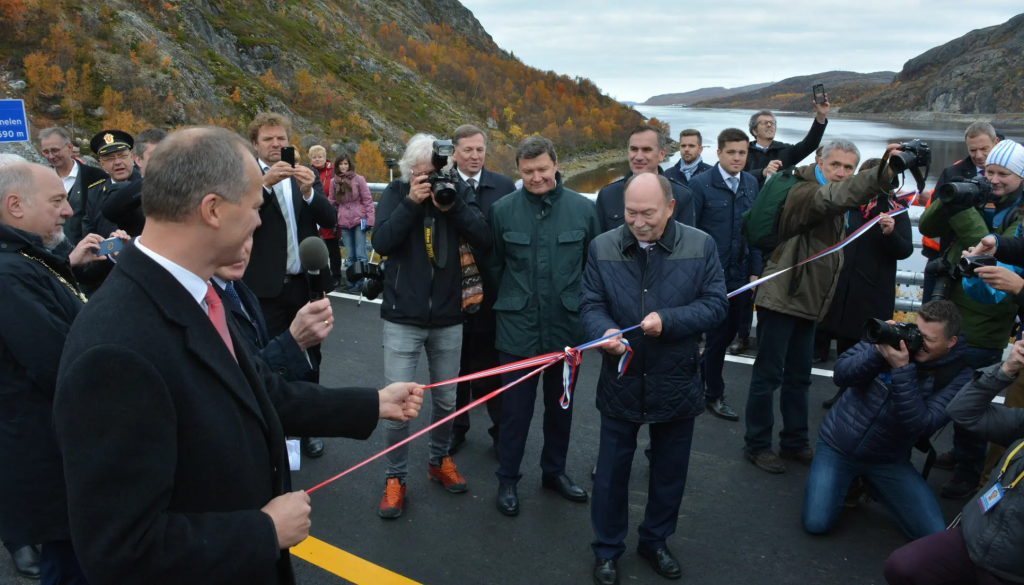
There was big celebration as government ministers from Oslo and Moscow in 2017 assembled on the brand new Bøkfjord Bridge.
The infrastructure object was part of a new cross-border road connection and was presented as a symbol of a good relationship between the countries.
“We have a mutual interest in further developing cooperation, for business, trade, education, environment and other areas,” Minister Ketil Solvik-Olsen said as he officially opened the 284-metre-long bridge across the Pasvik River.
Norway had spent 880 million kroner (€9,5 million) on the 12-kilometre-long connection, which included also a 685-metre-long tunnel.
The road is the northernmost part of the E-105 and the only infrastructure connection between Norway and Russia. As relations between the two countries gradually expanded, traffic boosted.
In 2013, relations peaked with more than 320,000 border-crossings at the Storskog checkpoint.
The subsequent year came Russia’s annexation of the Crimea and the incursions into the Donbas, and cross-border traveling, like cooperation in general, came to an irreversible decline.
The hopes for normalisation and democratisation failed to materialise and the Bøkfjord Bridge is today one of many symbols of a bygone era.
In a stark contrast to the festivity on Bøkfjord Bridge in 2017, Norway today works on a plan how to blow up bridges in case of a Russian military attack.
According to newspaper VG, the Norwegian government is in the process of establishing procedures for so-called ‘communication-disrupting measures’ for bridges and other infrastructure.
On the backdrop of the new measures is the situation in Ukraine, where advancing Russian forces repeatedly have been halted thanks to the demolition of bridges by the Ukrainians.
“Objects that the Armed Forces wish to destroy in wartime, with the aim of delaying enemy advances, must be prepared in peacetime. This increases the effect and reduces the cost,” says Anders Haavik-Nilsen, a representative of the Norwegian Defence Estates Agency, to VG.
The Norwegian Armed Forces do not want to reveal where the principle of ‘communication-disrupting measures’ will be applied.
But several new Norwegian bridges reportedly already have the new mechanism. It is not clear if the Bøkfjord Bridge is among them.
During the Cold War, all new bridges were built with the mechanism. The Russians have shown interest in several of them.
In July 2022, sailors from a Russian trawler moored in the Port of Kirkenes set off with a small boat to the Strømmen bridge, a piece of infrastructure that connects the Norwegian border town with the rest of Norway.
The sailors were caught by the police.

“I can confirm that people belonging to the Russian fishing boat Melkart-5 is fined for violating shore leave regulations by driving a small boat to Strømmen bridge,” Chief of Police in Finnmark, Ellen Katrine Hætta told to the Barents Observer.
During the Cold War, Norwegian military was tasked to blow up the Strømmen Bridge in case of a Soviet attack. In recent years, soldiers from the Garrison of Sør-Varanger (GSV) have again stepped up exercises near the bridge.
Related stories from around the North:
Canada: Canada launches partnerships to close Arctic military communications gap, Eye on the Arctic
Denmark: Danish intelligence report warns of US military threat under Trump, The Associated Press
Finland: Finland’s border fence almost ready in Lapland, Yle News
Iceland: NATO chief to Arctic Allies: “We’re all frontline states now,” as Iceland’s role grows, Eye on the Arctic
Norway: Suspected illegal Arctic border crossing from Russia to Norway, person detained, The Independent Barents Observer
Russia: Kremlin says Russia is interested in foreign investment, including Arctic, after U.S. plans report, TASS reports, Reuters
Sweden: NATO sends more ships to High North “amid increasing operational demands”, The Independent Barents Observer
United States: Washington’s new envoy to Denmark pledges more US support for Greenland, Reuters