Whitehorse grid-scale battery project won’t be ready by winter, utility says
By Caitrin Pilkington
Yukon Energy confirmed Thursday that its long-awaited grid-scale battery project will not be ready in time for winter.
In April, the utility had shared an optimistic press release about the project.
A positive site visit from the Canadian Standards Association — an independent third party that offers safety inspections — had created “confidence that the project is on track for completion this summer by the contractor.”
But this week, Yukon Energy said the timeline had changed. It would not be able to rely on the battery facility to provide dependable energy in the chillier months ahead.
“We’ve recently been informed by our contractor SunGrid that there is some uncertainty with project timelines,” said Keely Bass, a Yukon Energy spokesperson.
SunGrid did not respond to a request for an interview.
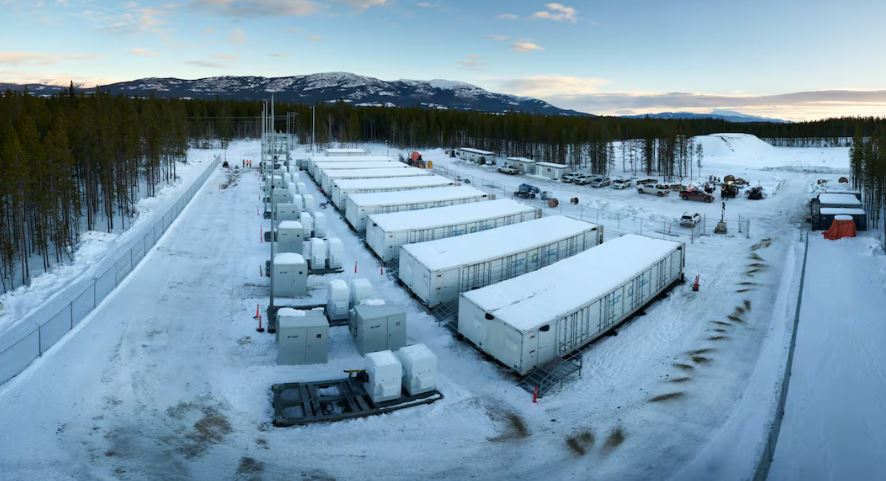
The setback marks the latest delay in a project that was initially expected to be complete by 2022. Once operational, it would see the territory become an operator of one of the largest grid-connected batteries in the country.
The project is intended to help the Yukon transition away from diesel, support the use of renewables, and allow excess energy generated during the summer months to be used during cold winters.
“The battery is designed to provide up to 17 megawatts of power at any one time and can supply that power for about two hours,” said Bass. “In practical terms, that means it can help meet peak electricity demand, support the grid during outages, and store energy for use when it’s needed most.”
Bass said commissioning and testing work on the battery facility will take place over the winter, and the utility is currently working with SunGrid to get an updated project schedule.
But even without the battery, Yukon Energy says it will be able to rely on additional diesel generators to produce 5.2 more megawatts of power this winter than in 2025, when the grid nearly reached its capacity.
Related stories from around the North:
Canada: Nunavut energy corp. applies to increase power rates by 9.5 per cent, CBC News
United States: New research suggest some salmon species expanding their range in the Arctic, Eye on the Arctic
Norway: Will the green transition be the new economic motor in the Arctic?, Eye on the Arctic
Sweden: Sweden’s climate policies closer to reaching goals, Radio Sweden