
Canadian Army looking for surveillance, cargo-drop drone suppliers, including for Arctic
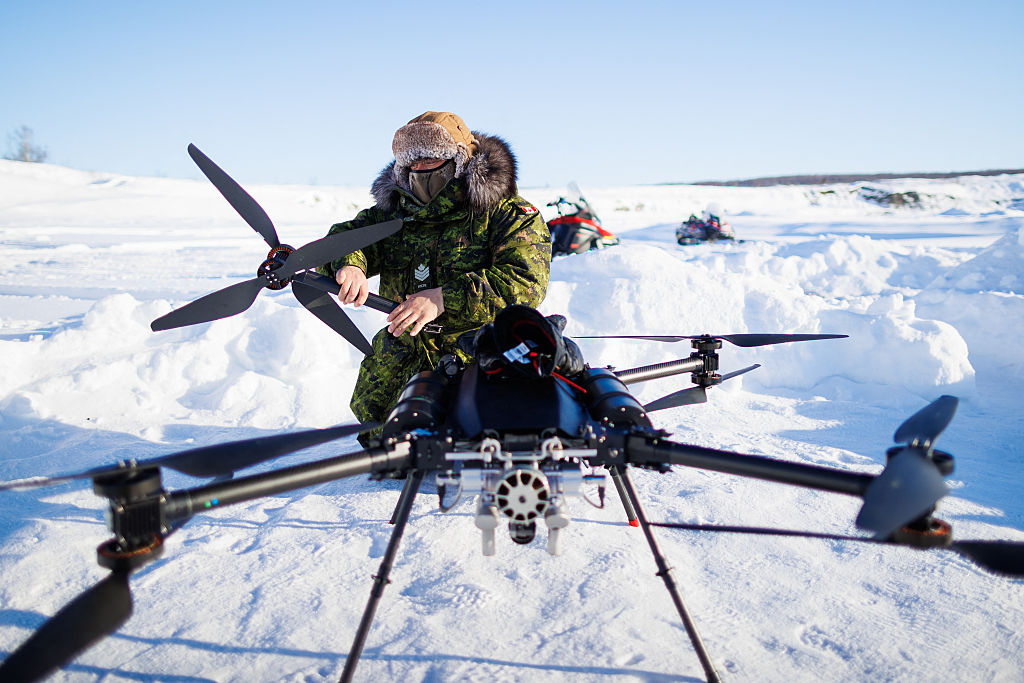
The federal government has put out a small shopping list for new drones for the Canadian Army, which includes land and aerial drones that can deliver cargo and supply munitions to troops.
It’s also looking for aerial surveillance and reconnaissance drones, including some specifically designed to operate in “extreme cold” Arctic environments.
Ottawa has issued a batch of five tenders under the army’s Minerva initiative, a program designed to integrate drones into its operations.
“The Canadian Army soldier will face an increasingly complex and dangerous battlespace in the future,” one of the drone tenders said.
“A major element of complexity and danger is the proliferation of multi-spectral sensors and precision weapons that will limit the [Canadian Army’s] ability to conduct intelligence gathering, surveillance and close reconnaissance without the risk of being targeted and attacked.”
Building up reserves
Alexander Salt, a senior researcher at the Canadian Global Affairs Institute defence think-tank, said these basic types of surveillance and logistics drones make a lot of sense as first steps for Canada to build up its reserves of different types of drones.
“The Canadian military is looking to scale up its size, but as we’ve seen in Ukraine, supply chains can be vulnerable,” he said.
“Russian drones are looking to strike convoys, looking for unprotected military assets. If you can take the human out of that, you now reduce your risk of casualties. So, having robotics helping to play a role in cargo delivery absolutely makes a lot of sense and is a fairly straightforward development.”
Canada’s military lags behind the pack in drone procurement as the technology has demonstrated its importance on the battlefield in Ukraine. But the military has been drafting up plans to catch up.
Army Commander Lt.-Gen. Michael Wright has said he wants to “flood” the army with drones under its modernization plan.
The federal government is at the same time creating a pool of pre-qualified suppliers that will let industry and the military work closer together on developing drone gear, and looking for ways to help build up domestic Canadian industry.
Autonomous systems as “sovereign capability”
The Liberal government’s defence industrial strategy highlights uncrewed and autonomous systems as a “sovereign capability” where the government will favour domestic production.
Salt said he thinks there will be “a lot of movement in this space” over the next year.
“Moving forward, and we’ve seen some signals of this, you’ll start to see some more complex systems, such as deep-strike capabilities potentially be integrated, as well as more full-autonomous orientated capabilities,” Salt said.
A federal briefing presentation to industry last month suggests uncrewed ground vehicles that cover complex terrain will be among the next drones the government will look to acquire.
The tenders note that companies will have to demonstrate their prototypes in Suffield, Alta.
CFB Suffield, with its large training area that stretches out across 2,700 square kilometers, is set to become a major test ground for drones, including by the British military.
The U.K. government’s own defence investment plan said the British government will “invest to exploit the size, scale and freedom of the key site in Canada for testing and evaluation and to accelerate delivery of capability.”
Related stories from around the North:
Canada: Canadian military surveys Arctic airstrips, infrastructure in Operation NANOOK exercise, CBC News
Denmark: Denmark to expand Arctic surveillance with purchase of long-range drones, Eye on the Arctic
Finland: Finland hails plan for allies to join NATO land forces in North, The Independent Barents Observer
Iceland: Europe’s Von der Leyen strengthens Arctic security ties with Iceland during visit, Eye on the Arctic
Norway: Norway softens self-imposed restrictions on allied surveillance aircraft monitoring Russia’s nuclear fleet, The Independent Barents Observer
Russia: Russian pilots learn to target long-range drones in Barents Sea combat drill, The Associated Press
Sweden: Nordic-Baltic region joins forces around Sweden’s CV90, The Independent Barents Observer
United States: White House releases U.S. Arctic strategy implementation plan, Eye on the Arctic