Q+A | National projects among top priorities for ITK president in 4th term
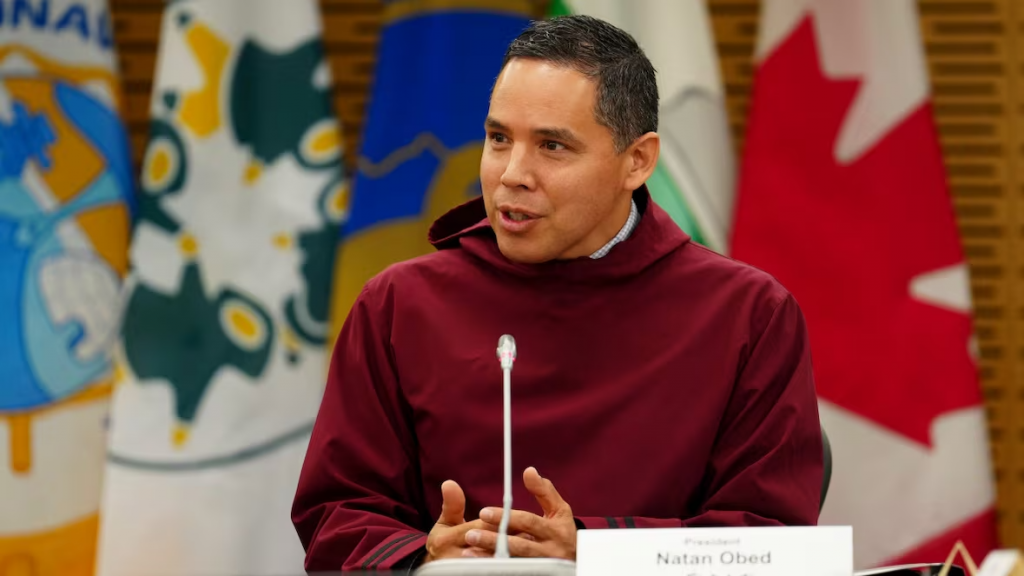
Inuit Nunangat University, Inuit unity and Inuit involvement in federal nation-building projects are some of the key priorities for Inuit Tapiriit Kanatami’s (ITK) president as he begins his fourth term leading the organization.
Natan Obed was re-elected last week as president of ITK, which advocates as the national voice of Inuit across Canada. The president is elected by representatives of ITK’s four director organizations: the Inuvialuit Regional Corporation, Nunavut Tunngavik Inc., Makivvik Corporation, and the Nunatsiavut government.
Obed has been ITK president since 2015. He spoke with CBC’s Trailbreaker host Shannon Scott about his vision for his new four-year term.
This interview has been edited for clarity and length.
What are your top priorities going into your fourth term as president?
We have an exciting project in the Inuit Nunangat University. We hope to open doors by 2030, but there’s a ton of stuff today between now and then, including raising money and finding a location and getting legislation to certify it. So that is a huge priority.
And we have the Qanuippitaa Health survey that has completed its field work across Inuit Nunangat. We hope to create summary data for the health of Inuit across Inuit Nunangat.
We also are in the phase of implementing Bill C-5 and listing national projects and really trying to ensure that Inuit rights and Inuit interests are upheld within this phase of nation-building projects and building one economy. We don’t want to be left behind, but we also want to ensure that the advances that we’ve made, such as the structures and provisions within our modern treaties, are upheld in the way in which we build this country.
To your mind, is it possible to reconcile moving these projects through faster with upholding modern treaty rights?
I think it is possible. The regulatory regimes that have been put in place, largely by provisions in our treaties across our homeland, are logical and can be followed. We want to see these projects move ahead, but we don’t want to have to sacrifice our processes or our environment to do so. In many cases, the Inuit are proponents of the projects that we’re putting forward.
Nunavut Tunngavik and the regional Inuit associations and the territorial government are the ones that are all saying that they are in support of moving these projects forward. Hopefully that will be where the Government of Canada starts and not try to imagine projects in our homeland without our participation. If the government goes down that route then it will be a challenge for them to meet their timelines and their ambition.
What do you make of this Liberal government so far, when it comes to advancing the interests of Inuit?
We have had really good conversations with the prime minister and also with the cabinet. This budget coming up in November will really see what they actually are going to do. And we are concerned that things like the Inuit Child First Initiative may be at risk of not being funded sustainably moving forward, or a lot of our social investments that are necessary for reconciliation such as tuberculosis elimination.
We have had good conversations so far, but there will be a reckoning very soon about what this government is willing to continue versus what it might want to draw back from, and our relationship will be heavily influenced by that.
With the renewed focus on the Arctic recently, particularly when it comes to security, what does ITK think about a more militarized Arctic in the future?
We’ve been through this once before. In the latter phases of World War II and into the Cold War era, there were over 60 military sites that were constructed across our homeland.
At that time, it was done without our consent or without our participation. These sites have transferred into dual use or community hubs, really places like Inuvik, Cambridge Bay, Rankin Inlet, Iqaluit, Kuujjuaq, the essential infrastructure that’s there was largely built by the U.S. military or Cold War interests.
So we’ve been through this, but this time around we want to be part of these conversations. We want to be essential partners within the considerations that Canada makes and the world makes in relation to the security of the Arctic and the sovereignty of Canada.
And this will really underpin the need for dual use infrastructure and local investment, investment in our Canadian Rangers, investment into airstrips and ports, and the consideration that in the end, Inuit communities are the reason why Canada has sovereignty over the Arctic. And investment in those communities is a part of the overarching effort that Canada needs to ensure that it provides funding for.
This is your fourth term. At the end of this term, what will success look like for you?
I bring it back to Inuit unity. I think the first thing that I think of as my job is to ensure that Inuit from across Inuit Nunangat, or wherever Inuit live, feel as though their national organization represents them. And that Inuit regions feel as though the decisions that they make together at the national level have been then implemented dutifully.
So that whenever I’m speaking, even to you today, that I am best representing the voices of Inuit leadership and that there is pride in Inuit unity, from Paulatuk all the way to Hopedale in Nunatsiavut, and it’s a special thing. Seeing people come together over a common cause and such a small population making such a big impact on the national stage, it’s only possible through unity. And so I want to do whatever I can to preserve it.
Related stories from around the North:
Canada: Tsiigehtchic, N.W.T., has a new chief. Here’s what she’s hoping to accomplish, CBC News
Finland: Finnish Court annuls 2023 Sámi elections, The Independent Barents Observer
Norway: Silje Karine Muotka is new President of the Sámi Parliament in Norway, The Independent Barents Observer