‘The space to practise culture’: Handgames beginners in Whitehorse find community and confidence
By
Ashley Russell is a beginner at handgames. She’s played before, in school and with her family, but she shies away from tournament settings where the players are practiced, the energy is intense, and the drums are flying.
“If you’re at all intimidated, nervous or not confident in your skills, you’re probably not gonna participate,” she said.
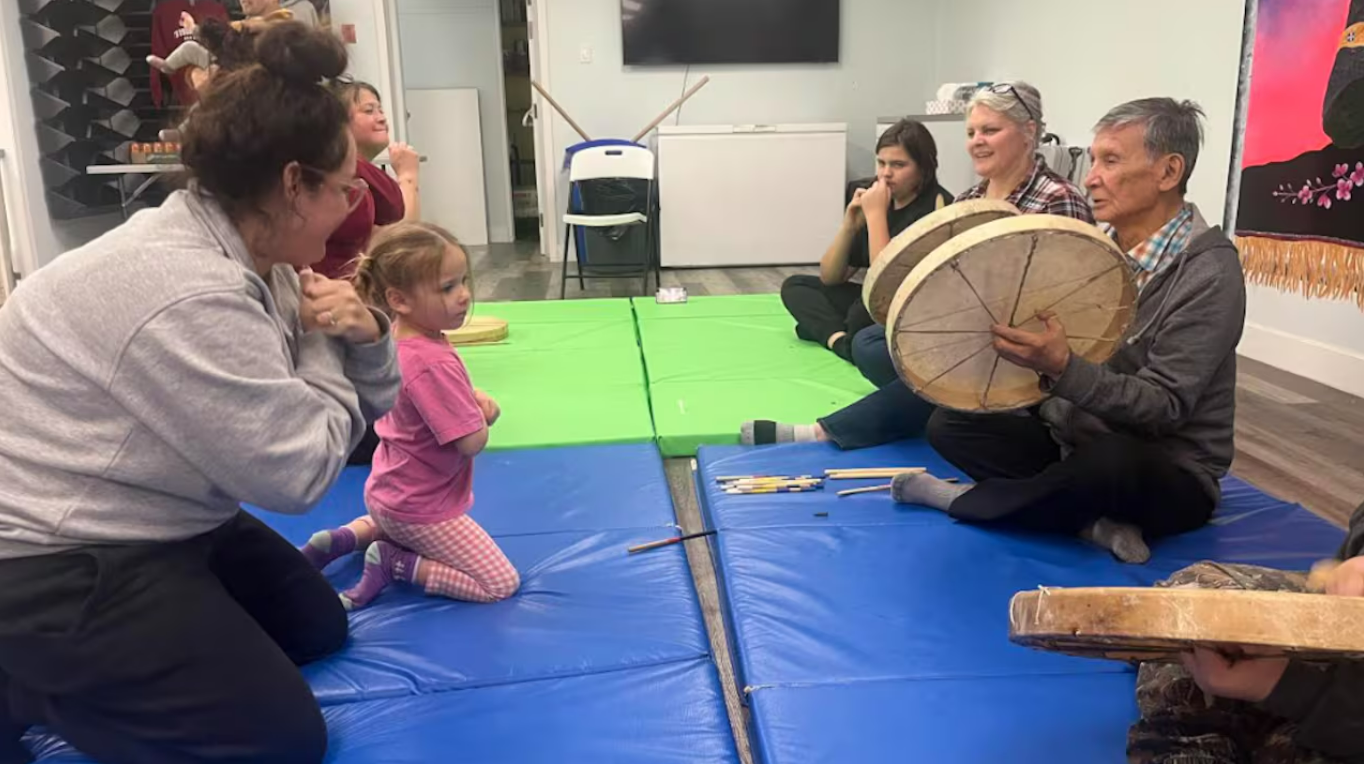
On Nov. 28 though, of the 10 or so people gathered in the basement of the Skookum Jim Friendship Centre in Whitehorse, she was among the more experienced.
Russell was at a workshop — handgames and drumming for absolute beginners — hosted by the Tr’ondëk Hwëch’in First Nation for Tr’ondëk Hwëch’in citizens living in Yukon’s capital.
Russell is Tr’ondëk Hwëch’in from Dawson City, Yukon, but has lived in Whitehorse for more than 15 years. A big part of what brought her to the workshop was connecting with others. She said that in Whitehorse, events for First Nations are often geared toward local nations and local citizens.
“It’s just hard to find community outside of community, and this is a great opportunity for that,” she said.
Roger Ellis is also a Tr’ondëk Hwëch’in citizen, and he was the teacher at the workshop. He’s been playing and teaching handgames and drumming for 45 years, having learned from players in Ross River and Pelly Crossing, Yukon.
Hand games involve drumming, guesswork and deception. With at least 19 different hand signals to memorize, Ellis’s best tips for beginners are to start slow, keep practising and don’t get mad.
He’s seen players run off crying, screaming and cursing when things don’t go their way. “Don’t take it personal,” he said. “It’s a fun game.”
Handgames have a long history in the North, rising and falling in popularity with the effects of colonialism and residential schools. Ellis said that before he started playing, around 1980, the sport was not widely played, having been nearly stamped out by government policies and residential schools.
Today, there’s no shortage of adults and kids who are eager to learn and keep the culture alive, said Ellis.
Charlie MacNeil is one of those kids. The 13-year-old is Ashley Russell’s son and he takes the game seriously. When the group played a couple of rounds, he was quick to point out who was accidentally cheating because they didn’t know the rules.
MacNeil learned to play at school, and said he likes the spirit and the energy of handgames.
That’s part of what Ellis loves about it, too. When people get into it, “it gets into your blood, in your system,” he said. “You start bouncing around.”
During one practice game, the energy in the room rose. At one point, there was an eruption of shouting and cheering. With a single hand signal, Russell had managed to get every player on the opposing team out.
She was smiling after the game, and reflected on the fact that she took on the role of caller, a position she’s avoided in the past because it means having your team count on you.
Russell said the beginner-friendly environment gave her confidence. “I learned that there’s a lot of other people that are at the same beginning level as me, and feel just as nervous as me.”
She hopes to see similar workshops in the future, maybe even a team of beginners, improving together.
“I think it’s just such a blessing that we have the space to practise our culture again,” said Russell. “It’s been missing for so long, and it’s just so beautiful to see the different generations come together and practise it so freely.”
Related stories from around the North:
Canada: Iqaluit Pan-Arctic Vision celebrates diversity, community and coming home to your cat, CBC News
Finland: Sami joik, symphonic music fusion from Finland makes int’l debut in Ottawa, Eye on the Arctic
Norway: Sami-led project seeks to revitalize Indigenous education across Europe, Eye on the Arctic
Sweden: Award-winning novel set in Sapmi to get Netflix treatment, Eye on the Arctic
United States: How Inuit culture helped unlock power of classical score for Inupiaq violinist, Eye on the Arctic