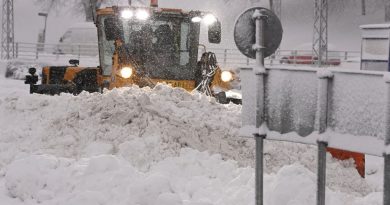
Transport company seeks better N.W.T. infrastructure amid road closures, climate crisis
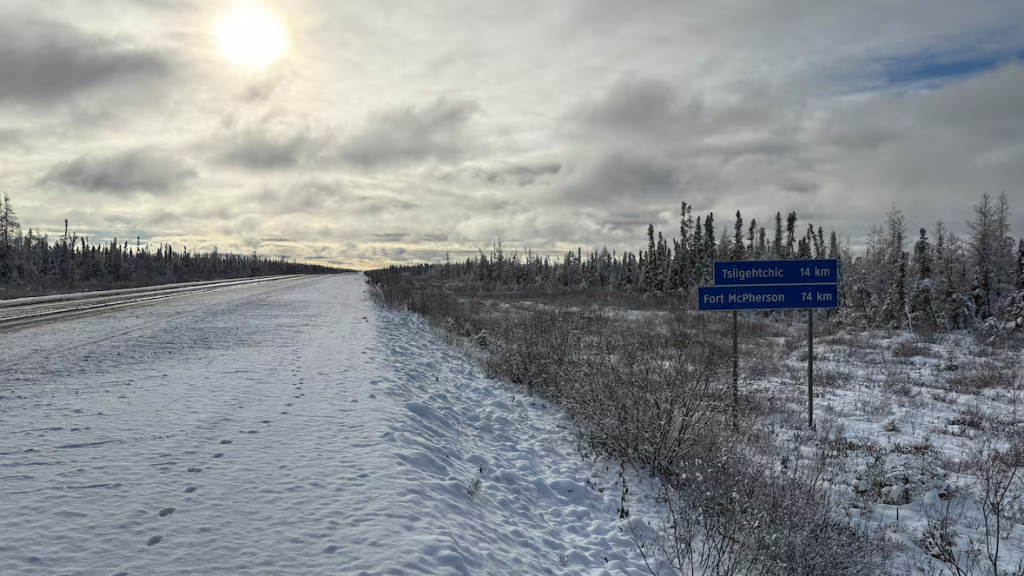
N.W.T. gov’t says it’s trying to keep up but needs more money from Ottawa
After 25 years of supplying essential goods like food to communities in the Northwest Territories, Manitoulin Transport is now worried about future operations because of worsening road closures due to climate change.
In recent weeks, the company has had several trucks stranded on the Dempster Highway, which faced a weeks-long closure due to wind and snow.
“It’s significant this year having nine trailer loads worth of product waiting to make their way in the communities,” Rob Eskens, the vice-president of sales at Manitoulin, said.
“It causes us a degree of anxiety because we know people are waiting for those goods.”

The company is also absorbing financial losses from replacing expired goods in trucks and spending more time in assessing increased safety risks for drivers, he said. Eskens also confirmed one of the company’s drivers recently had to be rescued due to an accident on the highway during a closure.
He’s asking the government of the Northwest Territories to make road infrastructure safer and increase snow clearing operations.
Binay Yadav, director of transportation with the N.W.T. Department of Infrastructure said while the government is using databases to forecast impacts of climate change on infrastructure — which helps in planning to rehabilitate roads and highways — the price tag remains a challenge.
“It’s billions and billions,” Yadav said.
“If you include the Mackenzie Valley Highway, it’s several billion. If you include the Arctic security corridor… that’s a few billion there… Generally money-wise we are in a struggle.”
Yadav said climate-related infrastructure challenges persist year-round and the cost to fix things continues to climb.
“Shorter construction window, limited industry capacity of consultants and contractors in the N.W.T., challenging access sites in remote locations … lack of high skilled workers … which adds up the cost of any infrastructure here in the N.W.T.,” Yadav said.
For example, in two years, the cost of steel on the Frank Channel Bridge replacement has gone up about 50 per cent and concrete is up by 104 per cent, he said.
Gov’t using research, new technology to forecast climate impact
The infrastructure department currently has five regional offices for snow operations and maintenance. But Yadav said the department must factor in the safety of staff during extreme weather conditions before deploying them.
The government is now collaborating with universities and researchers to improve infrastructure, he said.
“We are implementing several engineering studies during our planning and design, like terrain analysis, satellite imaging, imaginary thermal analysis, so that your infrastructure becomes better and the issues with infrastructure actually will not come,” Yadav said.
However, the territorial government is relying on federal money for new infrastructure and to make existing infrastructure more climate resilient, he said.

In an emailed statement, Environment and Climate Change Canada said the federal government has spent $6.6 billion in climate adaptation since 2015, but did not say how much of that money was directed to the N.W.T.
“As the impacts of climate change, such as sea level rise and coastal erosion, continue to progress in communities such as Tuktoyaktuk, the Government of Canada recognizes that a more ambitious, strategic and collaborative approach is required to adapt and build resilience,” spokesperson Samantha Bayard said.
Bayard said the government’s Canadian Centre for Climate Services, established in 2018, has been working closely with the Crown Indigenous and Northern Affairs Canada to develop climate data technology relevant to the North.
As for Eskens from Manitoulin Transport, he said his company is left questioning whether delivering via road will remain feasible.
Replacing a truck load of expired goods costs about $50,000, he said, and that’s on top of the cost to pay drivers stranded for long hours.
The company is now exploring alternatives, including air freight.
“If things do get dramatically worse in the future, we’ll have to work a lot closer together when it comes to logistics in the North,” Eskens said.
Related stories from around the North:
Canada: Greenland tensions sharpen focus on Arctic infrastructure gaps in Canada, Eye on the Arctic
Denmark: Denmark, Greenland agree to build naval wharf in Nuuk amid growing Arctic focus, Eye on the Arctic
Finland: Finland’s border fence almost ready in Lapland, Yle News