Premier will consider resigning if Yukon goes over debt cap, but commits to avoiding that
Yukon government wants feds to increase borrowing limit from $1.2 billion to $3 billion
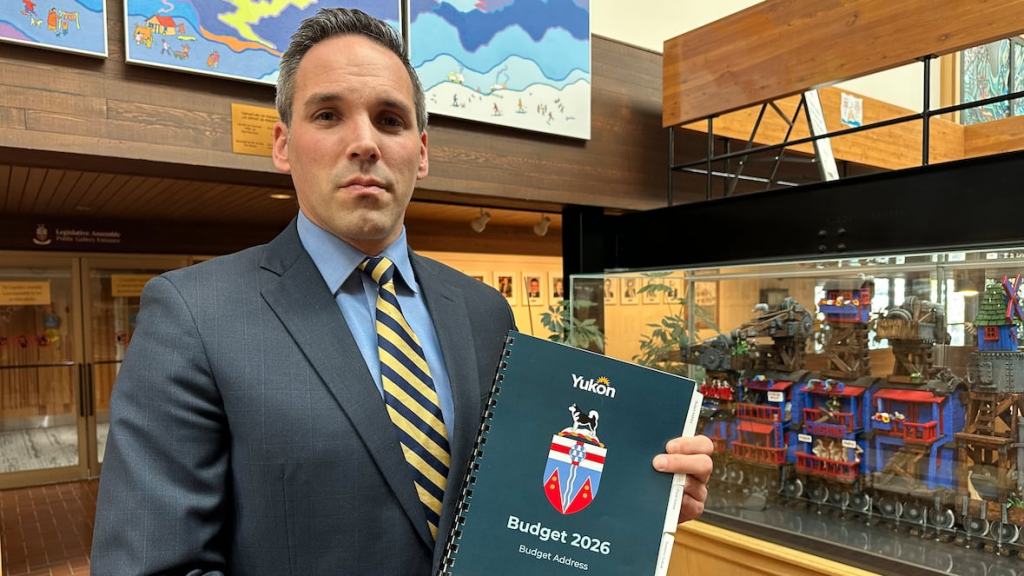
Premier Currie Dixon said he will think about resigning if the Yukon government breaches its borrowing limit, but he’s committed to ensuring that won’t happen, in part by asking the feds to more than double the territory’s debt cap.
Dixon, who is also the Yukon’s finance minister, met with federal Finance Minister François-Philippe Champagne last week. Ahead of that meeting, Dixon told CBC the federal government is still working out the details of the Yukon’s request.
“We will not go over the debt cap during my time as premier and finance minister,” Dixon said.
“That’s a hard commitment. In terms of the implications if we were to do it, well, I would have to think pretty seriously about resigning.”
CBC obtained correspondence between territorial and federal government representatives under an access to information request. A March 19 email from an assistant deputy minister suggests the territory will be at or near zero dollars away from its legal maximum “by January [2027], if historic patterns occur.”
Based on 2026-27 Yukon budget estimates, which were publicly released March 19, the email notes only $32 million remaining at the end of the fiscal year.
Dixon said those emails line up with what has been publicly communicated so far.
“We are essentially at the limit,” he said.
“We can’t substantially borrow any more right now. We have always maintained that we need to maintain a buffer between where we’re at and the actual hard cap itself because you never know what could happen over the course of a budget year.”
More than double
Dixon has asked the federal government to increase the amount the territorial government can borrow from $1.2 billion to $3 billion.
A big part of that request is intended to to pay for infrastructure gaps in energy and health care.
In a Feb. 10 letter to the federal minister, Dixon outlines the stress the health system faces. CBC reported the Whitehorse General Hospital hit 146 per cent capacity last month. The Yukon government is planning to expand the territory’s main hospital.
Meanwhile, the Yukon government has also been emphasizing energy needs, particularly since Whitehorse narrowly avoided rolling blackouts this past winter. It has a suite of plans to bolster the territory’s power supply, in part by repairing the Wareham dam spillway at Mayo’s hydro facility and building new fossil-fuel powered centres in Whitehorse.
Dixon’s letter suggests health and energy holes need to be filled to meet Canada’s economic and sovereignty plans.
Path to managing debt
Dixon said the federal government wants to see a debt management plan.
“That’s totally fine by us. We are happy to provide that because we feel the same way. We want to make sure that we’re not taking on debt irresponsibly,” he said.
“Our feeling has been that the previous government was fairly loose with how they took on debt, and we need to be more rigorous and thoughtful about how we take on new debt.”
In the meantime, Dixon said he is forced to make “difficult choices about our spending patterns.”
That’s why he said he previously announced that he’s carefully looking at transfer payment agreements to non-government organizations and reducing expenditures.
Paying for ‘big ticket items’
Keith Halliday is a local economist and writes the Yukonomist column for Yukon News.
“The borrowing limit is one of these financial rules that you have to respect,” he said. “[It’s] something that the federal government imposes on the territories, not the provinces … to ensure that they don’t borrow too much and get into financial trouble.”
Halliday noted the maximum amount the territory can borrow was just increased from $800 million to $1.2 billion less than two years ago. Prior to that, according to a Yukon government press release, it went up in 2009, 2012 and 2020.
He predicted the federal minister will grant the Yukon’s latest wish, then the onus will be on the premier to stay within the new limit while carrying out his party’s promises and the government’s capital spending plans.
Halliday said he foresees “tighter” territorial budgets in the coming years.
“I think any government coming into the office after the last election would have found itself, you know, needing to deal with this $1.2-billion debt limit and these big ticket items like the energy system, the hospital, Eagle Gold [Mine] and so on that are on the agenda,” he said.
“The core government had positive net financial assets when Liberal Premier Sandy Silver took office. And at the end of the Liberal government, including Premier [Ranj] Pillai’s time, you know, we had this very large debt in place.”
On July 13, S&P Global published its assessment of whether the territory can pay back its debt.
While tempering the territory’s spending will help operating balances bounce back, the report says borrowing for more spending on big projects will push up the total tax-supported debt in the short term. However, when compared to its provincial counterparts, the report says the Yukon’s debt burden remains relatively small.
Related stories from around the North:
Canada: Crucial for senators to be in Ottawa to represent North, former Nunavut representative says, CBC News
United States: Senators, including Alaska’s, sound alarm on cuts impacting Indigenous health care agency, Eye on the Arctic