Great Northern Arts Festival organizers looking ahead after funding turned down
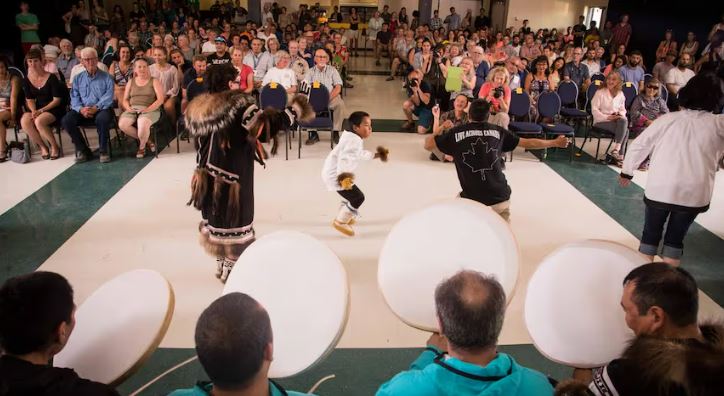
A major arts festival in Inuvik has been slowly coming back over the last few years, but organizers of the Great Northern Arts Festival (GNAF) are facing another hurdle, after the Canada Council for the Arts shot down two funding requests.
As first reported by Cabin Radio, Adi Winterbourne, the festival’s executive director, said organizers submitted two requests that would have totaled $90,000. She said it was “a little bit of a shock” to hear the festival wouldn’t get the money.
The funds would have helped cover costs of artists travelling to the festival and their accommodations, along with other core costs.
The festival has had to change strategies as a result.
“Right now we’re working independently with artists instead,” Winterbourne said. “We’re helping individual artists apply for their own grants, which in itself is a good skill to learn.”
Despite the challenges, Winterbourne said this summer’s festival will still go ahead.
“We’re going to make it work,” she said. “I think it’s such a strong community event and everybody really wants it to happen.”
The festival started in 1988 and used to run for about 10 days annually. Winterbourne said that all changed in about 2012, when the petroleum industry pulled out of the area. The festival became smaller for a few years and started to recover, before Covid-19 forced organizers to move it online for one year. It was cancelled for two years after that.
“Because we rely on a continuum of funding and we weren’t running a continuous event, then picking those funding sources back up was a really big issue,” Winterbourne said.
The festival came back in 2024.
“We started [in 2024] with a very low number in the bank account,” Winterbourne said. “We’ve been slowly rebuilding.”
‘It’s really helped me’
Artist Derrald Taylor, a soapstone carver from Tuktoyaktuk who’s currently based in Yellowknife, said he first attended the festival in 2000 or 2001, and had fond memories of his experiences there.
“It was really busy… with artists and with tourists,” Taylor said. “There were so many artists there and such a big turnout and it was really fun, fun to be working there.”
He noticed a difference between his first time at GNAF and the most recent festival he attended in 2017 or 2018.
“Usually we’d go up between 50 and 80, as far up as 100, 120 artists that were gathering there,” Taylor said. “The last festival I was at, there were probably about half as many artists. It was quiet. They didn’t have the funding.”
He said over the years, he’d found the festival helpful in a lot of ways.
“It’s really helped me in my artwork…especially working with others,” Taylor said. “I’m hoping that they can continue so that’ll help with the younger artists.”
Winterbourne said planning an event of this scale takes a long time. Planning often begins before the previous festival wraps up. Organizers already looking ahead to next year and working to secure funding for future events.
“We have a lot of confidence that it’s an event people love, and want to happen.”
In an email, a spokesperson for the Canada Council said the agency does not comment on specific funding requests. The spokesperson said the funding process is competitive and receiving funding in the past does not guarantee future requests will be approved.
A report written by Julia Parrish
Related stories from around the North:
Canada: Inuit and Korean artists collaborate for 2024 Gwangju Biennale, Eye on the Arctic
Finland: Sami joik, symphonic music fusion from Finland makes int’l debut in Ottawa, Eye on the Arctic
United States: How Inuit culture helped unlock power of classical score for Inupiaq violinist, Eye on the Arctic