Wind turbine going up a ‘big moment’ in Sanikiluaq, Nunavut
By Liny Lamberink
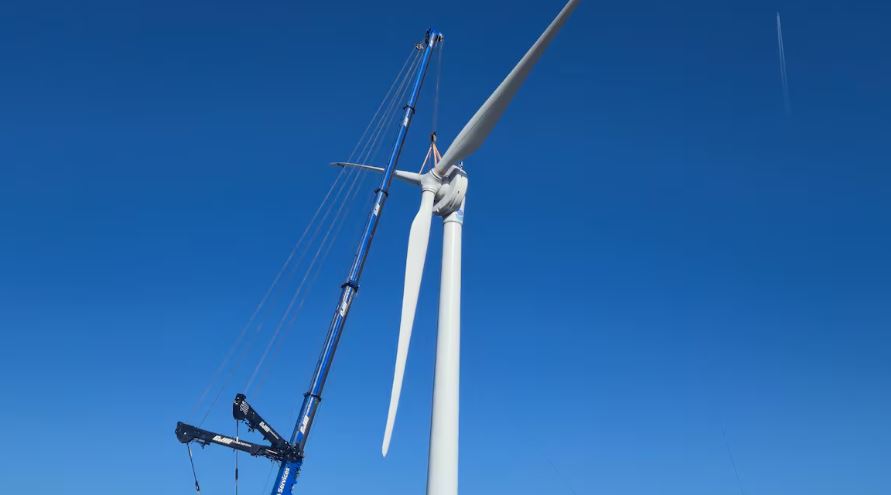
A wind turbine is now visible on the horizon, looking south from Sanikiluaq, Nunavut, though it isn’t producing power yet.
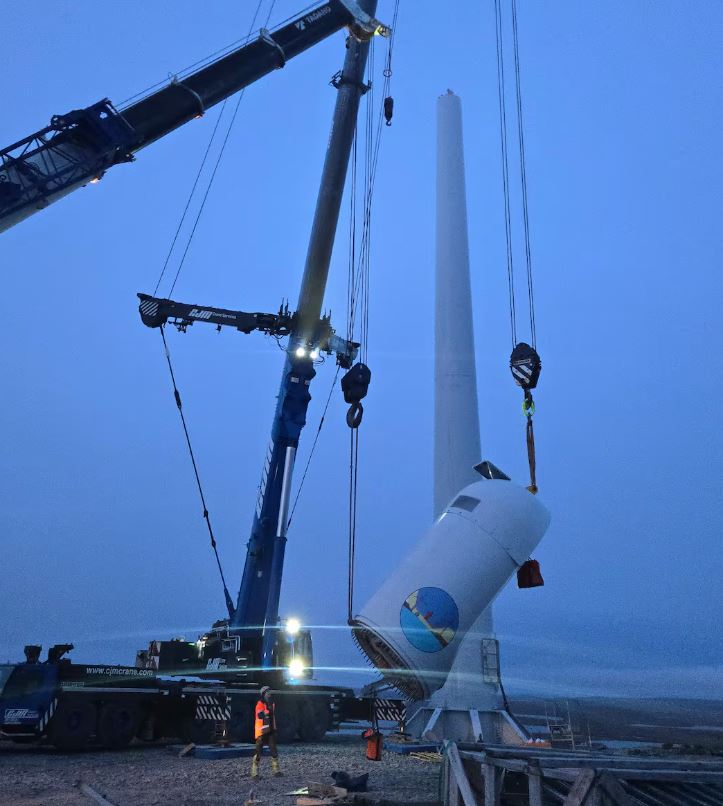
The structure was put up over the last few days. The tower went up on Thursday, said Clara Phillips, the development project manager for the Inuit-owned clean energy developer, Nunavut Nukkiksautiit Corporation (NNC). The blades were installed on Saturday.
“It’s a big moment,” said Phillips. “There’s been a lot of challenges on the project, so this feels like a really big achievement.”
NNC has been working with the Qulliq Energy Corporation (QEC) to install the $30 million wind turbine since 2016.
The Anuriqjuak Nukkiksautiit Project consists of a 1 megawatt turbine and 1 megawatt battery storage system.
They’re expected to displace at least 50 per cent of the diesel the community uses, which Phillips said amounts to about 600,000 litres per year. A portion of the profit NNC makes from selling power to QEC will go back into the small sub-Arctic community.
But the work isn’t over.
Phillips said there’s more construction to do, and upgrades are needed on the existing diesel power plant to integrate wind power. Then comes the commissioning process, which she described as a series of tests both by NNC and by QEC to make sure the turbine operates the way it’s supposed to.
“QEC’s ultimate responsibility is to provide safe, reliable power to the community. So we need to make sure our system is helping them meet that requirement,” she said.
Phillips hopes the turbine will be generating power this year, but said it depends on other factors — like whether the rest of the work can be done in what’s left of the community’s short construction season.
How Sanikiluaq will benefit
Johnny Appaqaq, Sanikiluaq’s mayor, said it’ll be good to have an alternative source of power in the community in case something happens to QEC’s diesel generators.
There was an outage that lasted about nine hours in some parts of the community earlier this month.
“It’ll be less stressful for the diesel engines,” he said.

Appaqaq’s senior administrative officer, Robert Hedley, said the project should extend the life of those diesel engines and offset the community’s carbon footprint in a big way.
That said, he’s keeping his expectations reserved.
“Once … it’s up and operational, then we’ll see how it goes,” he said.
“NNC has been a real partner with the community, it’s been really really encouraging in that respect.”
Some profit goes back to community
Phillips describes the project as the first of its kind in Nunavut, because it’s the first community-scale wind project in the territory to be established under QEC’s independent power producer program.
The program allows producers to generate electricity from renewable energy sources and to sell that power back to QEC. The utility then sells and distributes that power around communities.
The Ikayuut solar project that came online earlier this month in Naujaat is part of the same program.
Phillips said NNC signed an energy purchase agreement with QEC back in 2023. It lays out a price that QEC will pay for the electricity — about 27 cents per kilowatt hour — based on how much money the utility won’t have to spend on diesel.
The community of Sanikiluaq in late September 2026. If all goes to plan, it could be using wind power sometime this year. (Liny Lamberink/CBC)
Part of the wind turbine’s profits will also go back to the community. Phillips said 20 per cent of the profits will go into a community enhancement fund, which is governed by a committee made up of municipal leaders, members of the hunters and trappers association, youth and elders.
“We want to ensure that the community is seeing economic benefits from the project,” said Phillips.
Phillips said funding for the project comes from a few different sources. Natural Resources Canada provided $16.7 million, the Qikiqtani Inuit Association provided $7 million, and NNC received a $6.7 million loan from the Canada Infrastructure Bank.
Related stories from around the North:
Canada: N.W.T. gov’t tells power companies to plan to increase use of renewable energy, CBC News
Finland: Record December passenger numbers for airports in Arctic Finland, Eye on the Arctic
Greenland: New Copenhagen-Kangerlussuaq flight aims to boost Greenland tourism, Eye on the Arctic
Sweden: Northern Scandinavia to pioneer commercial flights with electric planes, Radio Sweden