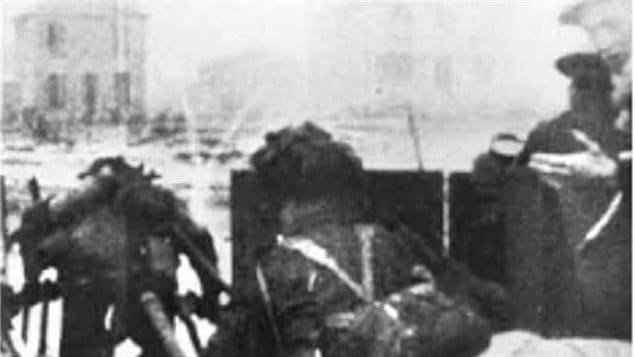
In the early hours of June 6, 1944, Over 150,000 soldiers in the Allied Forces from thousands of ships and boats, stormed the beaches of Normandy, France.

It was the beginning of the land battle to defeat Nazi Germany. Some 14 thousand Canadian soldiers from the 3rd Canadian Division landed at the zone labelled Juno, a flat beach about 8 km wide laden with mines and swept by curtains of machine gun fire.
The Canadians fought their way inland, to the towns of Bernieres, Courseulles, and St Aubin, and continued inland. By the end of the day and against incredibly fierce resistance, the Canadians were the only force to have achieved their initial objectives.
Later they would join up with the 450 Canadian paratroops, part of a larger paratroop force, that had landed the day before behind enemy lines to destroy supply lines.
John Keegan, eminent British historian who wrote Six Armies in Normandy, stated the following concerning the Canadian 3rd Division on D-Day: “At the end of the day, its forward elements stood deeper into France than those of any other division. The opposition the Canadians faced was stronger than that of any other beach save Omaha. That was an accomplishment in which the whole nation could take considerable pride.”






For reasons beyond our control, and for an undetermined period of time, our comment section is now closed. However, our social networks remain open to your contributions.