
Former worker recalls year spent at Arctic weather station now set for clean-up
· CBC News
Doug Munson was fresh out of high school when he went to work at Isachsen station in the 1970s
When 19-year-old Doug Munson got an interview with the federal government in 1974 for a job up north, he didn’t understand what exactly he would be signing up for.
“They had a map of the High Arctic and said, ‘oh, by the way, this is where you’ll be going,’” Munson recalled.
“I said I’ll give it a try, I’m willing. And that was good enough for them.”
Munson was a fresh-out-of-high-school southern Ontario farmboy when he travelled thousands of kilometres north to the Isachsen High Arctic weather station, just 1,300 kilometres from the North Pole.
More than half a century later, Isachsen station has been long abandoned and is considered a contaminated site. The federal government is now making plans to remediate the former Cold War era station, beginning next summer.
The site is filled with hazardous chemicals including asbestos, lead, mercury and mould, and represents an “environmental risk,” according to documents the Department of Environment and Climate Change Canada (ECCC) submitted to the Nunavut Impact Review Board (NIRB).
Munson has vivid memories of his time working at the site in the 1970s, and says it had a big impact on his personal and family life.
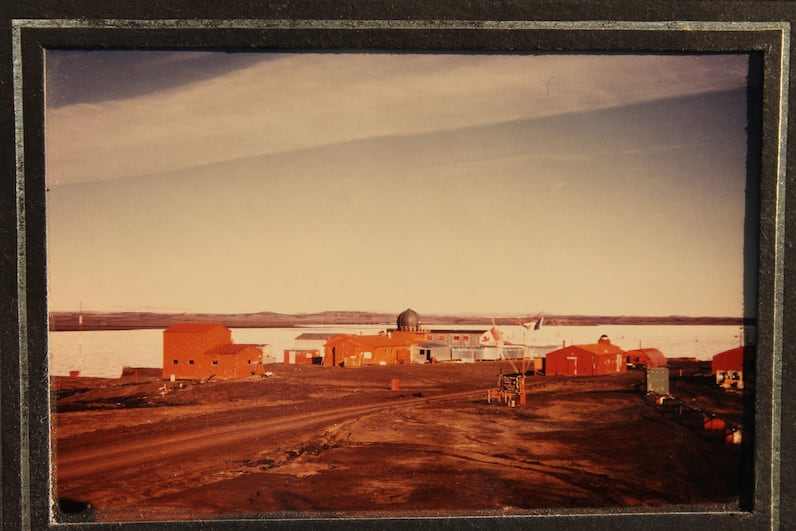
The station was created after the Second World War as part of a joint Canada-U.S. weather observation program.
All of the buildings were painted orange so that landing planes could easily find them in the tundra, Munson said.
For a year, he and a team of about a dozen meteorologists worked 56 hours a week tracking temperature, humidity and winds in the region.
In their free time, they would go hiking on the tundra, listen to Sunday night hockey games on CBC Radio, or play a game or two themselves with some makeshift gear.
“We actually made our own hockey sticks and played hockey in the warehouse,” he recalled.
That year at Isachsen station was also challenging for Munson. Over the dark winter months there, he made just one diary entry.
That diary was eventually discovered 40 years later by Munson’s son, photographer and filmmaker aAron Munson, who was struck by his father’s bleak writings.
“He was talking just about how isolated and lonely he felt and just didn’t really care about living anymore,” aAron said.
After reading that diary entry, aAron decided he wanted to visit Isachsen station himself. In 2016, he spent $30,000 to fly there and spent a week camping in one of the abandoned buildings, photographing the remnants of the once-busy site.
There were old fuel drums, snow-covered lounge chairs, and an old yellow Chrysler Dodge truck that his father remembered driving.
“Even the dishes, in the kitchen. There are still dishes just sitting there,” aAron said.
He described it as an eerie experience, calling a “ghost station” holding the memories of many people who spent time there. He thought about his dad, sitting in the same room, decades earlier.
“He probably could have never imagined that his son would one day come back to sit in that same spot and kind of reflect on his journey,” aAron said.
Two years after that trip, aAron assembled the photos he took into a collection called Isachsen.
In 1978, Isachsen station was shut down as it became obsolete.
Despite the challenges he faced there, Doug says it’s sad to know that the site will be gone.
“There’s no more buildings to go back to, but we got pictures and memories,” Doug said. “What more can you do?”


!["Nobody cares for our concerns,” says Jerry Natanine, mayor of Clyde River, Nunavut. “And our Minister [of the Environment] in Ottawa, Leona Aglukkaq, not speaking up against this for Inuit is very wrong.” (Courtesy Jerry Natanine)](https://www.rcinet.ca/eye-on-the-arctic/wp-content/uploads/sites/30/2014/07/jerry-natanine-390x205.jpg)