
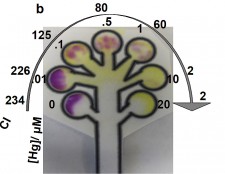
A multiplexed sensor test strip for detection of heavy metals, this one is showing detection of mercury which causes the purple colour to decrease as a printed enzyme is inhibited by the metal.
Without water, we simply can’t exist, and safe drinking water is becoming an increasing concern.
A Canadian scientist and team have developed a quick and simple method of detecting a wide variety of bacteria and chemicals in water.
These are simple, specially treated strips of paper that can almost instantly indicate if there is a quality problem.John Brennan, is a professor in the Department of Chemistry and Chemical biology ,and Canada Research Chair in Bio-analytical Chemistry and Biointerfaces at McMaster University in Hamilton, Ontario. He is also Director of the Bio-interfaces Institute.
ListenMunicipal water treatment plants sometimes aren’t able to test quickly enough for water quality problems, and don’t test for all the chemicals that are in our environment, nor are they always able to react in a timely fashion .

Water samples are often sent to laboratories for testing which can result in varying degrees of time lapse between testing and determination that there is a problem, which may require treatment intervention and perhaps a “boil water” order, or even a “stop use” order.
During that interval, people may become ill, and in some cases die of water-borne infections or chemicals.
Professor Brennan has been developing a simple and low-cost rapid testing method using simple chemically-reactive paper strips, much like the over-the-couter test strips for pregnancy for example
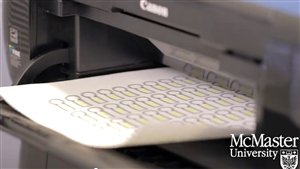
The strips can test for specific things like the presence of a pesticide, or a bacteria in lakes or municipal drinking water, or can also be created to test for the presence of several different chemicals and/or bacteria simultaneously.
Currently undergoing verification and scale-up development to large scale production.
The hope is that they will soon be available to municipal and commercial users, and also eventually to consumers.
Canada’s Natural Sciences and Engineering Research Council (NSERC) is providing funding to help in the development.
If verification and scale-up trials go well, this new development may be ready for the market within two to three years.






For reasons beyond our control, and for an undetermined period of time, our comment section is now closed. However, our social networks remain open to your contributions.