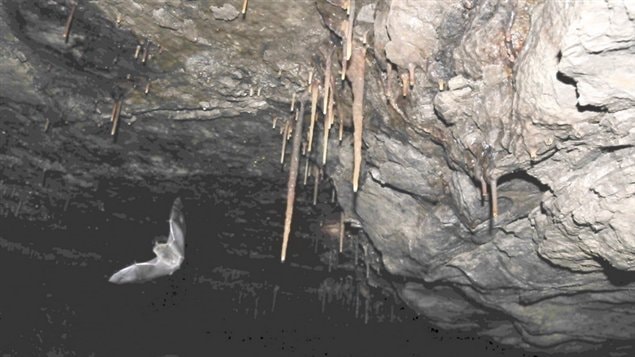
The population of little brown bats is up in the western province of Alberta, while bats are dying in droves from white-nose syndrome in the east. It’s estimated a fungus has killed more than 5.7 million bats in North America, since the first cases were noted in New York State in the winter of 2006.
It’s believed the fungus originated in Europe where bats seem to have some immunity, and that it was brought to North America by some human vector. The disease causes bats on this continent to wake up during hibernation, wasting energy they need to conserve in order to survive.
Cave visitors could spread disease
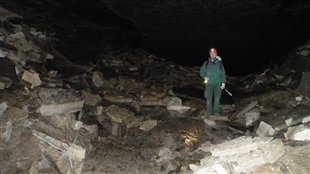
Most white-nose syndrome is spread by bat-to-bat transmission and, since they mostly have a small range, its progress is usually slow. But officials in Alberta worry cave explorers may inadvertently spread the disease, so they have closed several caves to the public.
“Our main concern is the threat that humans can become involved,” says Dave Hobson, a wildlife biologist with Alberta government. “Somebody could go into a cave in the eastern United States or in (the province of) Ontario, pick up some spores on their clothing and …go visit a cave in Alberta and spread it that way. That way it could jump across the continent very quickly.”
Alberta has closed several caves to the public to try to prevent the spread of white-nose syndrome. Cadomin Cave in Whitehorse Wildland Provincial Park and Wapiabi Cave in Wapiabi Provincial Park near the Rocky Mountains were popular spots to visit but are open no longer.
Decontamination required
Cavers have also been warned to never visit any Alberta cave wearing the same clothing they wore to explore a cave in the eastern part of the country. They have also been told to sterilize their boots, clothing and equipment between visits to any cave at all.
The U.S. government has issued decontamination protocols and Canada is considering doing the same. Wildlife officials think it’s probably inevitable the disease will spread west regardless, but they hope to slow it down long enough for science to give them some tools to mitigate its effects.
Farms and forests need bats
Canadian bats are the biggest predator of night insects and their decimation would mean farmers and foresters would have to dramatically increase their use of pesticides.






For reasons beyond our control, and for an undetermined period of time, our comment section is now closed. However, our social networks remain open to your contributions.