Future wildfires likely to impede construction on Mackenzie Valley Highway, expert says
‘If you’re dodging wildfires during construction season, it’s going to create a challenge,’ says Ze’ev Gedalof
Longer fire seasons, larger fires and melting permafrost: all things that contribute to what one climate expert says is shrinking the window of opportunity to build a major infrastructure project in the Northwest Territories.
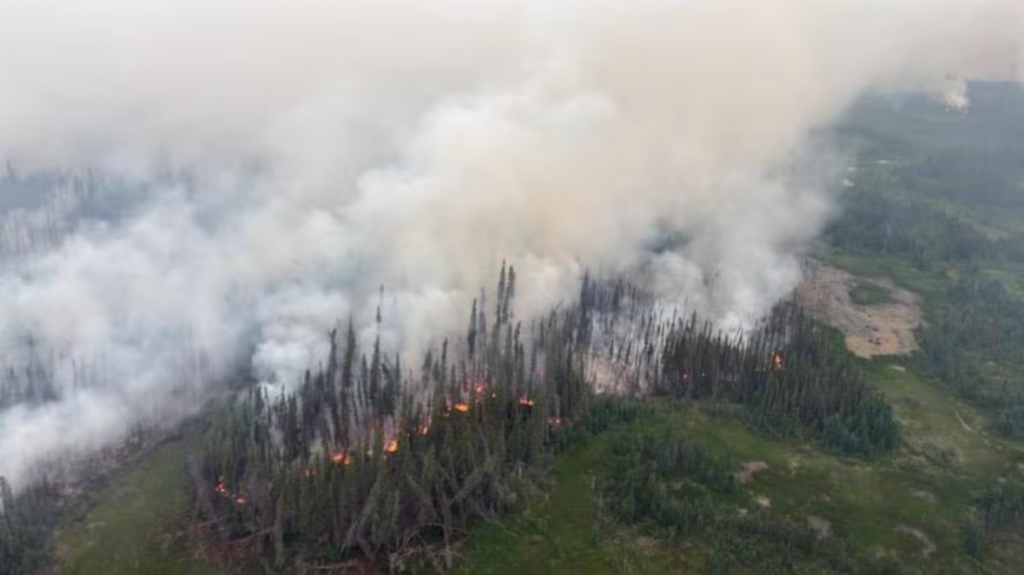
Last month, the federal government told CBC News that wildfires in the territory were so out of control, it’s stopping work on the Mackenzie Valley Highway — a proposed all-season gravel road that would stretch from Wrigley to Inuvik, connecting many of the territory’s remote communities.
“As communities across the North respond to the impacts of wildfires, the safety and security of Canadians remain the top priority. Work will not begin until wildfire conditions are under control and it is safe to proceed,” reads a prepared statement from the office of the federal minister of transport.
Ze’ev Gedalof, an associate professor and climate scientist at the University of Guelph, says that’s likely to continue, as wildfires appear to be the new normal for the N.W.T.
“It’s starting to seem like this is just happening every year,” he said.
Gedalof says the territory also has another climate-related problem during the winter, with shorter ice road seasons.
“Just moving materials around, you’re getting less time to do that,” Gedalof said. “And then if you’re dodging wildfires during construction season, it’s going to create a challenge for sure.”
In recent years, wildfires in the N.W.T. have forced several communities to evacuate.
As of Monday, there are more than 200 active wildfires in the N.W.T., most of which are considered out of control.
A recent study from the World Weather Attribution also found that this year’s wildfire event is now expected to occur once every two to six years in the Northwest Territories in today’s climate.
Without climate change, it would occur less than once every 40 years, according to the study’s findings.
‘We take it step by step,’ territory’s MP says
The Mackenzie Valley Highway has been talked about for decades, touted as a means of lowering the cost of living in the territory and to exert sovereignty in the North.
But what’ll happen to its future, and whether they foresee harsh wildfire seasons becoming a recurring issue so severe it routinely stops work on the highway — some of the country’s leaders can’t say.
“It’s mother nature, so we take it step by step,” said Rebecca Alty, the territory’s member of parliament, who is also the Crown-Indigenous Relations minister.
While visiting Yellowknife, federal minister of emergency management, Eleanor Olszewski, also told CBC News she’s concerned how climate change has impacted wildfires across Canada, including the N.W.T.
She cited her colleagues’ point too.
“We can’t really control, a lot of times, what happens with respect to natural disasters like wildfires,” Olszewski said.
She said governments can still prepare for fires and communicate with the public. People can also reduce the number of human-caused wildfires, she said.
Even still, “unfortunately, we are probably going to see wildfires continue,” said Olszewski.
She says there would be repercussions if the highway faces continued delays because of wildfires, but did not elaborate on what that would look like.
If highway isn’t built, ‘that would be a massive failure,’ says premier
CBC News asked for an interview with the territory’s own environment minister, Jay Macdonald. His office said he was travelling but is working on a response.
On a podcast this week, Premier R.J. Simpson was asked what would force him to publicly say he failed as the territory’s leader. His answer: not getting the Mackenzie Valley Highway built.
“That would be a massive failure,” he said. “This is something that generations of people in the territory have wanted to see.”
“I would really hang my head in shame if that fell apart,” Simpson said.
Simpson was not referring to wildfires potentially stopping construction in his answer. He said he’s confident in the federal government’s interest in the North and hopes to see “full construction start next year,” also during that podcast.
Related stories from around the North:
Canada: Greenland tensions sharpen focus on Arctic infrastructure gaps in Canada, Eye on the Arctic
Denmark: Denmark, Greenland agree to build naval wharf in Nuuk amid growing Arctic focus, Eye on the Arctic
Finland: Wildfires continue to burn across Lapland, Yle News
Norway: Smoke from Canadian wildfires forecast to reach Norway, The Associated Press
Russia: New NOAA report finds vast Siberian wildfires linked to Arctic warming, The Associated Press
Sweden: High risk of wildfires in many parts of Sweden, including North, Radio Sweden
United States: Wildfires in Anchorage? Climate change sparks disaster fears, The Associated Press