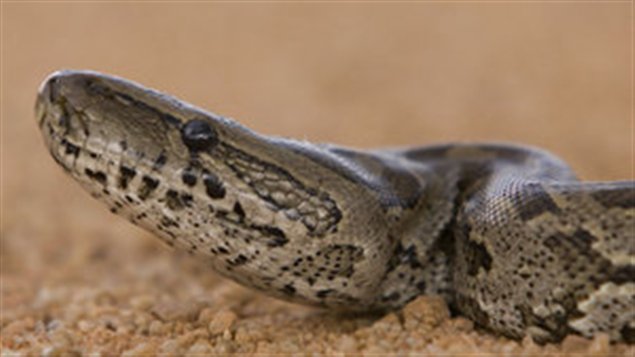

python in Eastern Canada. © CBC
The deaths of two little boys in New Brunswick this week bring to 19 the number of North Americans killed by giant, constricting snakes kept as pets since 1978.
“But that doesn’t include a litany of other kinds of injuries,” said Rob Laidlaw, executive director of Zoocheck, wildlife protection group based in Toronto.
“For anybody who knows the snakes, they have very large sets —up to 120– of these things called recurved teeth that are very sharp. And pythons, many of them are very aggressive. So you have all kinds of situations in which there are severe lacerations, there are bite wounds that require medical intervention or even hospitalization and we have no handle on those.”
If you add in the people who are injured by other dangerous animals like big cats, Laidlaw estimates there are thousands of people who have been hurt by exotic animals kept as pets.
Thriving trade in exotic animals
There is a thriving exotic animal trade in Canada and very little regulation. Unlike Britain, Canada has no country-wide rules about private trade and possession of exotic animals. Some provinces have rules, others have passed on the issue to municipalities which are often ill-equipped to deal with it.
The province of British Columbia passed a Controlled Alien Species Regulation after a woman was killed by her boyfriend’s pet tiger in 2009. It places strict limits on owners of exotic animals and bars big cats, venomous snakes, large reptiles and privates from being imported.
In the province of Ontario a man was killed by a python in 1992. A coroner’s inquest recommended legislation to deal with the dangers of exotic pets but none was passed.

and little regulation. © CBC
Rules “a bit of a mess”
“It really is a bit of a mess,” says Laidlaw. “And there’s a lot of places you can go in Canada if you’ve got a tiger or a spitting cobra and there really aren’t any rules at all.
Stronger provincial laws to limit or ban the import and sale of exotic species should be passed in the view of the Canadian Federation of Humane Societies and other animal welfare groups. Because of the jurisdictional powers of provinces in Canada there is a limit to what can be done at the national level.
“What the federal government could act on in a very expeditious way would be the import of these animals,” suggests Laidlaw. “I would say there’s compelling reasons for banning the whole exotic pet trade regardless of species.”
Millions of animals traded yearly
It’s estimated that 12 million exotic animals are traded every year around the world. Many are plucked directly from the wild. An estimated 90 per cent die within the first two years of captivity.
“I think it’s important to remember that while there are human victims of attacks like this…there are also millions and millions of animal victims,” says Laidlaw. “And that’s something that shouldn’t be acceptable to anybody…Basic human compassion should tell you that it’s time for this kind of thing to stop.”






For reasons beyond our control, and for an undetermined period of time, our comment section is now closed. However, our social networks remain open to your contributions.