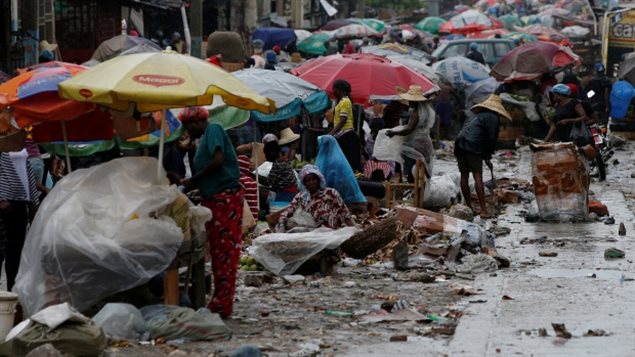
Haitian-Canadians, particularly those in the large community in Montreal, have been watching their island homeland over the last couple of days in the hope it would be spared further tragedy during Hurricane Matthew.
“Since the earthquake, basically, there was two hurricanes and one tropical storm, and then those two droughts”
According to the latest reports, 5 people were killed and there is widespread damage, but Jean-Michel Vigreux of CARE Haiti, says it is still too early to assess exactly what happened. Early today Vigreux said the rain had stopped and the winds had died down in the capital, Port au Prince, but that was not yet the case in the southeastern tip of the island.
ListenHurricane Matthew, a category 4 storm, is continuing up the east coast of the United States, where people are preparing for it, but few places are as vulnerable as Haiti. Vigreux says the assessment and evaluation of the needs of the people have yet to be determined but CARE had already distributed over 3500 meals in the Port au Prince area yesterday.
The group has begun distributing food and clean drinking water to some of the emergency shelters in Grand Anse, South-East, and Port-au-Prince. And in anticipation of the hurricane, CARE had pre-positioned supplies of clean drinking water, tarps, and blankets for emergency shelter as well as hygiene kits, in the remote areas that are now isolated in the wake of the storm.
“Resilience has its own limits”

“It’s really difficult and challenging particularly for the vulnerable and poor households, Vigreux says. “It’s difficult to cope with all those disasters.” Disasters that arrived in succession over the last five years, he explains: “Since the earthquake, basically, there was two hurricanes and one tropical storm, and then those two droughts, so it’s basically very challenging for people to cope with the shock.” He says even the Haitians, known for their fortitude, have a limit, and that “resilience has its own limits”.
Vigreux says aid agencies can, as they have been doing, help in the immediate disaster response, but ultimately they have to help the people build their society. CARE has been helping with financial resilience, supporting over 2,000 savings and loan associations in Haiti, with over 65,000 direct participants in the program.
CARE is also working on a social protection safety net with the government for the most vulnerable in the country, providing cash transfers or food transfers to more than 200,000 people.
When asked about the infrastructure in the wake of the earthquake, Vigreux says a lot has been done. CARE contributed to the retro-fitting and refurbishing of many houses in the Port au Prince area. And the group is currently completing a one-and-a-half mile stretch of road in a heavily populated area of the city.
But Vigreux says the environmental resilience of the country continues to be a major challenge. The heavy rain that came with this hurricane caused more mudslides and the ongoing deforestation that makes agriculture so difficult.
Now, however, the massive flooding and contaminated water are of immediate concern. CARE is providing clean drinking water and distributing water purification tablets, while working with the government and UN community to assess the damage and scale up the response as soon as they know more about the need.



For reasons beyond our control, and for an undetermined period of time, our comment section is now closed. However, our social networks remain open to your contributions.